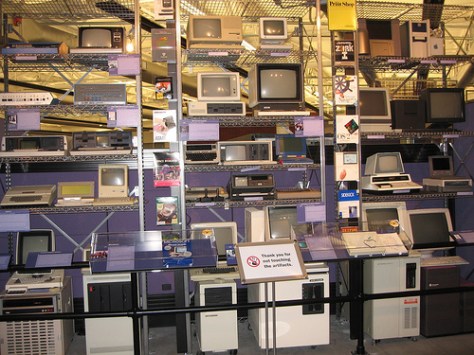
When I started writing this blog post, I wanted to rant about computers and software in general, then throw in a few more rants about backups and data storage. Unfortunately, as I really got heated up, I realized this is kind of a big topic. My solution is to split the rant into 3 parts. Before I launch into my first epic/pointless rant, I want to give a little bit of perspective as to why I felt I should waste my time (and yours, should you carelessly read beyond the first paragraph).
One of my many hobbies is wood working. Over the years I’ve collected a truly eclectic selection of saws, jigs, and stuff that specializes in turning fingers into hamburger. The more I work, the more I realize the importance of the right tool for the job, and not just the right tool, but really good tools. In general, I’d argue that the better the tool, the more productive you are. Yes, I can build cabinets with a guide and a circular saw, that totally works, but I couldn’t do it professionally without a cabinet saw.
I feel that writing is the same. You need to have tools that work and help to make you more productive. Unlike with woodworking where tools have a fairly specific domain and price is generally commensurate with quality and usability, writing tools have no such simple guidelines.
With that out of the way, the first thing I want to rant about is computers and operating systems. As a programmer, gamer, and data analyst, I already demand quite a bit from any given computing device, however I’m going to focus just on the perspective of a writer, specifically a writer who is trying to construct a series of novels and also chip away at other projects.
A lot of writers use paper to draft their initial work. I’m not one of those. My handwriting is borderline illegible, doesn’t offer spell-check, and subject to coffee damage. It’s not that I don’t use notebooks, I do, it’s just that I prefer to write on a computer, I’m a lot faster and it suits my work habits a lot better. Needless to say I use my computer a LOT. A knee-jerk reaction might be – Any computer will work right?
No, and this is why this is a rant.
First off, the older I get the less patience I have for things that don’t work the way I need them to. If I have to fight with something, and can’t implement my own fix, I really just feel like it’s not worth my time. This is especially true if I had to pay for it. To be clear, I have my favorites, but every platform has some limitation or problem. No matter what, you’ve got to be willing to put up with one problem or another. Choosing a good computer is more a matter of picking which problems are the least annoying. Let’s go down the list.
I’ll start with mobile platforms (let’s just lump iPad, Surface, Nexus, Galaxy, and so on into a single category). There are two key problems you’ve got to deal with. The first is the ability to manage documents. These types of devices allow one document to be open at a time, and to be really effective, require you to use some cloud-based hosting service for your data, which I suppose is fine, but it’s not particularly efficient and requires you to have access to Wi-Fi whenever you want to work. While Wi-Fi is ubiquitous, it’s not a guarantee. For drafting an initial manuscript or jotting down ideas I think these platforms are convenient, but really work out to the equivalent of a very expensive pad of paper. Thinking about only getting one document at a time, imagine you’re trying to do research and cross-reference some notes? Perhaps you’re attempting to make some edits that will blend events in two chapters to make one good chapter instead of two weak ones? Put multiple documents together? These devices aren’t designed for that sort of work flow. Trying to manage a large scale-project with lots of files would be challenging to impossible on one of these things. The other key problem is the interface. A touch-screen isn’t an ideal way to type and the tiny plug-in keyboards you get for most of these are not comfortable for lots of writing. Not only that, I cringe to think of the challenge in copying, pasting, and formatting on those.
I’ve never used Chrome OS, but it’s the sort of platform you’d have to lump with mobile platforms. Despite the fact that this tends to be packaged as a laptop, it’s more like a mobile platform in functionality. Yes, it’s inexpensive, but it lacks the range of software that I would consider adequate for managing a complex writing project (or several).
Apple is an excellent platform, but it’s outrageously expensive. The cost alone makes it an impractical option for me, not to mention the suite of available applications is a little smaller than I’d like, though that’s generally not a total deal-breaker for me. As a writer, if you can afford a macbook pro, this is, in my opinion, the best option. That said, you can pick up a MacMini for a reasonable price, but it lacks the mobility of a laptop, and for writers, this is usually a problem. It certainly is for me.
Ubuntu is also a very good platform, it’s inexpensive and flexible. In terms of cost, it’s great, but the limited application and hardware support really make it challenging to use. What really makes this platform work for me is that if something isn’t working properly, I’ve got the flexibility of manipulating it until it does work.
I’d like to say that Windows really is the best option because of it’s reasonably affordable price tag (even for a 15” laptop), vast list of available software, reasonably stable configuration, and wide ranging support of hardware, but I can’t. Ever since Windows 8 arrived, it’s been buggy, the document management has become difficult to impossible*, and trying to work through the interface is an extreme headache. Even more so than learning a brand-new OS like Ubuntu Linux. My wife struggles with the new system daily, and I’ve had more than one help-support type call from family. I pin most of the issues with Windows on Microsoft trying to apply a mobile paradigm to a platform for which it makes no sense. Even Apple, the reigning champion of ‘do everything with us’ realizes that mobile devices are used differently than laptop and desktop computers. My own ranting aside, a large majority of computer users will find this to be the best platform.
Because of limitations in opening multiple documents simultaneously, and the general difficulty in using the system, Windows is no longer an option for me. The usability problems outweigh virtually every other problem on other platforms, especially when there are less expensive options available. This leaves me with two realistic alternatives -Mac or Ubuntu. As much as I would prefer to go with Apple, the cost of a comfortably large laptop is prohibitive. Therefore, I went with an Ubuntu laptop for my primary setup. It’s what I’ve been using for years. Sure, I’ve been without certain amenities, but I haven’t found that I really need them. At least until a few months ago when I started seriously looking into the steps one needs to take after finishing a novel.
With that in mind, I’ve recently augmented my computing environment with a MacMini, it’s about the same price as a good Windows desktop, but without all of the Windows problems. MacMini combined with Ubuntu laptop is STILL cheaper than a macbook pro, by half. So, now I get access to the applications I want moving into the next stage of novel writing as well as the portability I want.
This sounds like a good solution, so what’s the problem?
In short – working across multiple platforms, but that’s only part of the problem. It really doesn’t matter what platform you select, there are going to be difficulties. What are the problems? Stay tuned, I’ll continue this rant later.
* I’m extremely concerned about trying to bring this into the workplace someday. Most of my job is managing documents. I worry about the shiny new limitations related to organizing and managing thousands of documents, having multiple files open simultaneously, and the manner in which file storage is obfuscated to the point where you’re obligated to search for your document instead of navigating directly to it. I expect this will have a notable effect on productivity.
photo credit: IMG_0561 via photopin (license)




 On Writing Dragons