Existential crisis of a writer

At the Alaska Writer’s Guild annual conference, I heard a lot of things. So many of those things stuck with me as really good and legitimately helpful advice. I will go on about that quite a bit over the next few weeks in part because I’m still digesting what I heard and writing it out like this helps me to understand it. That said, one of the things that hit me, and is still hitting me, is this question:

Why do we write?

If you’d asked me that question before last week, I’d have selected one of the following clichés:

– Because I love doing it, and I want to keep doing it,

– Because I want to be a professional writer when I grow up,

– Because it legitimizes my wearing of socks and sandals in a way nothing else can.

Okay, I made that last one up, that’s being a programmer. Being a programmer does that. So the real answer, and one I’m embarrassed to say someone had to tell me, is that we write to be read. Wow. Okay. That distills it down to the very heart of the matter, doesn’t it? I think that ought to be enough for me to just carry on and keep writing. After all, it’s not exactly an earth shattering revelation. Yet, it still nags me, because I can’t get past the second why. This is the why that hangs out with a but just at the end of the to be read.

Why? It’s the ultimate existential question isn’t it? You can why anything to death. I keep wanting to come back round to the why I do this, but here’s the kicker, it’s not about me at all. If I make it about me, then I’m missing the point. I’d like to think what I write is humorous. Perhaps not outright funny, but silly in a slightly better than slapstick way. Attempting to be humorous adds something to my work for sure. When I started doing that, the quality of my writing increased dramatically. Even I like it better and I’m extremely hard on myself. I’ve even gotten a few compliments, and compliments feel good. For me, the best compliment is “I’m really enjoying this.” I’m not really looking for anything more than that. There it is again, that me thing, but that’s why I do it, we’re talking the second why, not the first one.

To get back to the first ‘why’ in ‘why do we write’, it’s a two way street isn’t it? I get satisfaction from hearing the words “I’m enjoying this.” and the reader has clearly gotten something from it. They’ve gotten what I was hoping they would get out of it. The problem here is that it’s all too easy to focus exclusively on the ‘me’ portion of the equation and not the reader portion. I’m not saying it’s all about working out exactly what an audience wants to see, because quite often they don’t know what they want, that’s why creative people exist, to make up the new things that people didn’t know they wanted until they have it in front of them.

In any case, this is something for me to ponder and think about as I work through the difficult process of getting enough pre-orders to publish Wine Bottles and Broomsticks on Inkshares, and moving forward too into other projects that will need to find the readers that need them.
Breaking a Fairy Tale 

Except for my efforts to get Wine Bottles and Broomsticks published on inkshares.com I’ve got two major works in progress at the moment. The first is the Deep Space Help Desk – I really want to knock that out, but I got stuck -I have to back up a chapter or two and take a different angle. Really, I just need a solid day to focus on that project to get it put back on the rails again. The second project, The Dark Queen of Darkness, is in slightly better shape, even if I’m finding it a slightly more difficult project to write. 

The Dark Queen of Darkness is an unexpected project. It launched as a way to test out my new iOS version of Scrivener, and also an excersize in employing tricks learned (stolen) from Terry Pratchett. Not so much as taking his words or style as incorporating parts of his approach to story telling, it appeals to me and, as they say, what doesn’t kill you or get you sued for copyright infringement will only make you stronger. In any case, the story has taken hold because it’s got a fairly clear trajectory. At least, it has if I treat it like a fairy tale, albeit a seriously broken, yet true-to-form fairy tale.

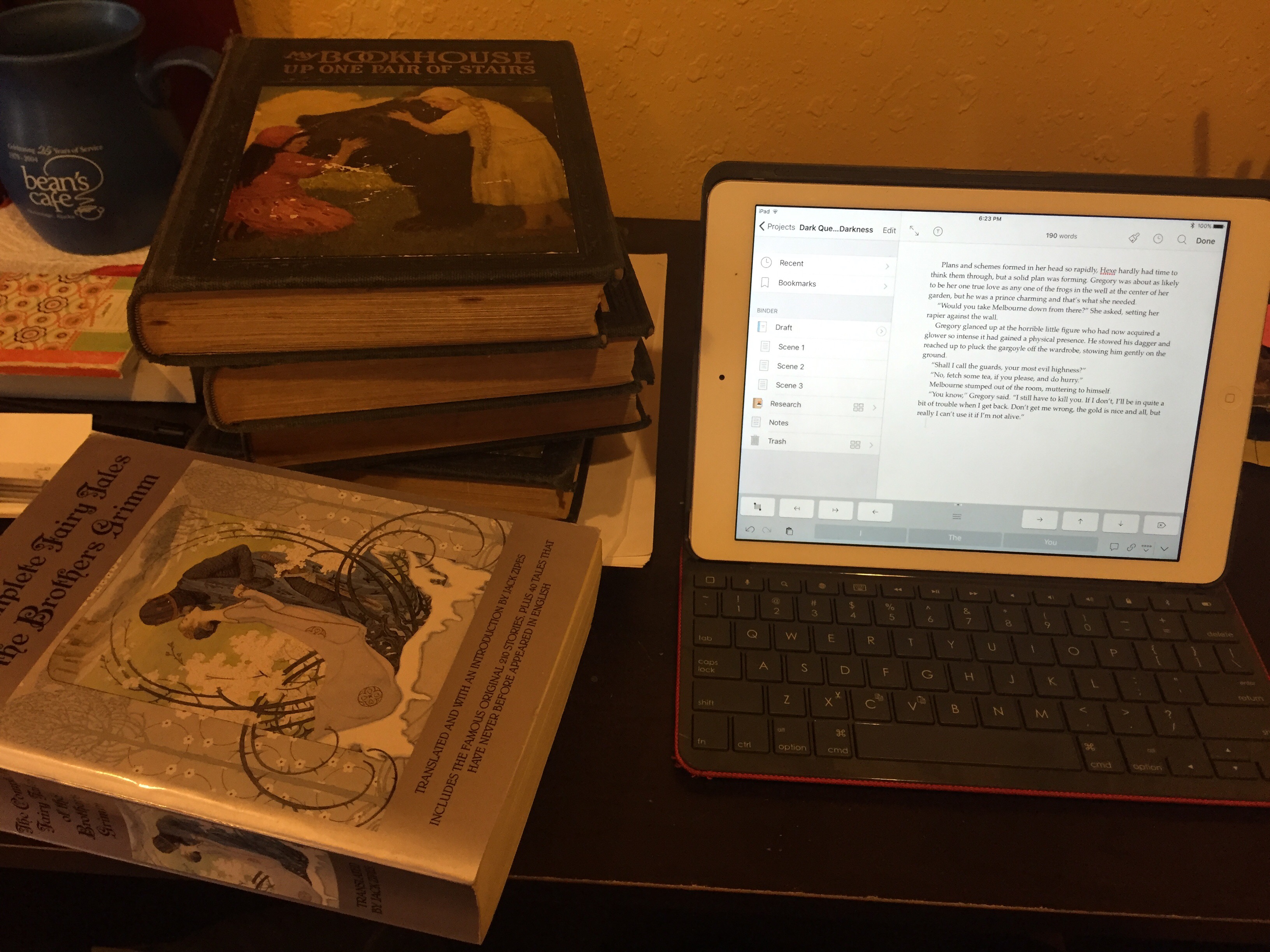
With all that in mind, and some advice received after sharing the first part of the first chapter, I went back and pivoted slightly more toward a YA vibe, and starting working the fairy tale angle a little harder. Right now, I’m looking largely at Snow White, while brining in characters from other tales. This isn’t anything like a new idea, but it’s a new approach for me. I also happen to be fortunate enough to have in my possession a stack of books containing hundreds of old fairy-tales with a publication date of 1928, which I realize as I write this puts these books at nearly 90 years old – the oldest we have in the house by a considerable number of decades. The image up top features one of these books with the illustration of Snow White and Rose Red, which I only know because I read that one last night from the other book of Grimm’s Fairy Tales.

In any case, the idea with this story is to make it an upside-down fairy tale that takes on the well trodden tropes and re-uses them in a slightly bent or fully ironic manner. For example, there’s the huntsman. He appears in a bunch of stories, I’m going to work him in with a lead role. Prince Charming comes in all over the place, even if not by that name. He’ll appear, after all how could a good, epic fairy tale end without a kiss by a Prince Charming? I’ll also see about writing in some dwarves, trolls, elves, wizards, and other various characters. With that, I’m off to do a bit of research and plotting.

Tangents are not a type of citrus fruit

When I was in high-school I was introduced to tangents. In spite of the fact that tangent sounds vaguely like a small, tart citrus, in school it was used to mean a bit of mathematical wizardry involving one of those sweet graphic calculators. While I have no recollection on how to deal with tangents, I still feel strongly about how edible they sound. Of course, none of this has to do with the sort of tangent I’m thinking of right now. Mostly. 

The more I hear and read about proper plot construction, the more I keep hearing about this plot arc thing. It makes me thing of something  roundish or possibly completely round. This is not, usually, how I think about story telling. I tend to think about a story in terms of straight lines. Action A happens, so that B can happen, which causes C, and so-on. But, since it’s supposed to be an arc, I guess those things happen around a circle, which is illogical, but fine, I suppose.

Today, while my wife was putting together her blog post/newspaper article, she asked me to look it over. It was good. Usually is. This one was no exception, it was a solid piece. Then came the part that nobody likes to face. The bit where she asked, what do you think? So, I told her. Then she asked, Is it funny? That’s the sort of thing that makes my blood run cold.  Because my first thought was no, not really, but why the hell should it be. It’s good by itself. Anyone who’s ever given advice to a writer knows that just saying yes, it’s good, in spite of the fact that it is good, but not quite what the author thinks it is is easy, but stupid. In all cases, it will result in hours of questions like “really?” And “You think so?” With a smattering of “it’s good huh?” And “you think it’s funny?” Even though my wife most obligingly tells me my work is both good and funny, I decided to be honest. I said, “it’s a good and entertaining read, but I wouldn’t describe it as funny.”

“How do I make it funny?” Was her response. How could it not be? It’s the same thing I’d ask.

Naturally, I have absolutely no good response. If I had, I’d be a hell of a lot more successful writer than I am. That said, there is a feature in humorous writing, once pointed out, is obvious. Some humor takes lead up, planning and perfect execution, other humor simply requires profoundly artful understatement, and then there’s the tangent. Not the small tart citrus variety or the mathematical wizardry sort either, though if we’re sticking to the plot arc description, the mathematical tangent is a pretty good way to visualize this one. 

I asked my wife to think about the funniest book she’d read in a long time, which is a fun thing to visualize because watching my wife read something hilarious or just really funny is entertainment itself. I mean, except the parts where she’s laughing hard enough to challenge a blueberry for color. We came up with Terry Pratchett. One of the tricks he employs in his humor is the tangent. It works basically like this. You start your story and sporadically deviate with a vignette that theatrically embellish some tangentially related detail. I’d give an excellent example just now, but I think it would be better to just think about a funny story and go back to that. Look for the tangent. 

To be clear, I have no illusion that pulling off this little trick this makes you a funny writer, it’s a hell of a lot more work than that. but it is a trick that works. Anyhow, that’s what I wanted to share. I think it’s good advice, I mean, if you’re looking for it.