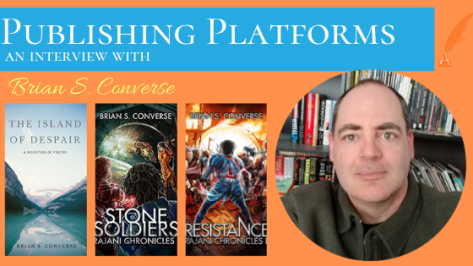
Publishing platforms interview #9, featuring Brian Converse

Brian S. Converse

For this installment of Publishing Platforms, where I’m endeavoring to talk to almost as many authors as I can find leading up to self-publishing my own work, Dark Queen of Darkness this fall, I’ve reached out to Brian S. Converse to discuss his experiences in publishing. I met Brian on Twitter, as one does, and have been following his progress in publishing and marketing his series Rajani Chronicles. Below are the questions I asked, in an interview format.

D: Hi Brian, thanks for joining me. Before I launch into my questions, could you tell us a bit more about yourself and your work?

BSC: Sure, Dave, thanks for inviting me. I’ve been writing for about 25 years now in various formats, both traditionally published and self-published. I’ve had poems, comics, and short stories published in various zines, both print and electronic. As you mentioned, I am self-publishing my first novel series, Rajani Chronicles.

D: I apologize, this one is solidly multi-part  –In looking at where you’ve made your work available, one that stands out to me is Smashwords. I’ve only heard about this one peripherally and I don’t know anything about it. Was it difficult to put your book into the variety of formats available there? In terms of sales and things, how does it stack up to other platforms, such as Amazon? Would you recommend this platform to other authors?

BSC: Smashwords is probably the most difficult to get your manuscript ready for print. You have to have some patience with their Word format converter, which they call Meat Grinder, because it can be picky, but as long as you follow their style guide it should go smoothly. Smashwords then publishes it along [with] a few different platforms such as their own, KOBO, Apple, Barnes & Noble, etc. You just need to pick those options when you upload the book. My Smashwords sales are inconsistent, and not as strong as my Amazon sales, but as you said, that may just be due to people being unfamiliar with the site. One thing I have found, though, is that they are easier to deal with than Amazon when it comes to changing the price of your book for sales and promotions. I would recommend Smashwords, but only if you don’t want to go exclusive with Amazon.

D: Another platform you’re available on is KOBO. Until I started seriously looking into publishing, I’d thought this was a fully deceased avenue. However, the more of the interviews I do and the more I learn about other authors, I’m noticing this is a pretty common publishing platform. Could you describe a bit of your experience there? Does it seem like people are finding your work and buying through Kobo?

BSC: I’ve only sold a few books through KOBO. Again, that may be due to people being unfamiliar with the site. I think readers naturally go to what is familiar to them, and Amazon seems to be it, unless they own a specific e-reader like NOOK.

D: Your books are available in paperback (and hardback!!!!) format through Amazon. Do you exclusively print through Amazon or did you use any other service, like Lulu, Blurb, IngramSpark, bookbaby etc… to print?

BSC: All of my paperbacks and hardcovers are printed through IngramSpark. It’s a fairly easy process to upload the book and cover artwork. They offer options for sizes, paper color, cover format (glossy vs matte) and hardcover and/or softcover. Once the novel goes live, then it’s automatically picked up by Amazon as long as you have an ISBN. Remember, you need an individual ISBN for each book format, hardcover, softcover, ebook, nook, audio, etc. And the only place to get them is through Bowker.

D: In sort of a follow-up to the question [If applicable, depending on how you respond] – did you consider using any of those services when you looked into publishing? Why/Why not?

BSC: I looked into a few of the book publishing services when I first began exploring self-publishing, but I wanted to know how to do it on my own, and the best way to learn is by doing. There was a definite learning curve when I first started, but the second book was much easier than the first.

D: Your novels are self-published, as is your work of poetry. Did you consider going traditional or reaching out to a small press before you launched? Why/Why not?

BSC: I did participate in a few of the Twitter pitches that are available (pitmad, sffpit) on the first book, and was not happy with the offers I got, or was not picked up by some of the publishers that “liked” my pitch tweet. By that time, though, I had already made up my mind to self-publish, so it was more of a novelty to see how it all worked on Twitter. The poetry book I decided to release exclusively on Amazon as an ebook knowing that there isn’t a great demand for poetry out there, but wanting it to be available to people that do read it. I also wanted it to be as low-budget as I could make it, which is why I used Canva to create a cover and don’t have it offered as a print book.

D: The illustrations on your covers are excellent. Who did the artwork and how did you find that person?

BSC: His name is Lawrence Mann, and he is a digital artist based in England. We follow each other on Twitter (I don’t remember who followed who first) and when I started the process of self-publishing, I looked at his web site (https://lawrencemann.co.uk/) and really liked his work, so I contacted him and we went from there.

D: One of the things I decided to do with The Dark Queen of Darkness was to hire an editor. This was a pretty expensive undertaking, but one I felt necessary for my own work. What approach did you take to editing for the Rajani Chronicles? Why?

BSC: Always get a professional editor to go over your manuscript. This shouldn’t even be a choice. As a writer with many years of experience, I’ve found that no matter how polished you think your work is, it’s not a good idea to rely on just yourself. Sometimes you’re too close to the work; you’ve read through it so many times that you overlook something. Again, my editor was someone that I found on Twitter. One thing I will tell people, though, is shop around for the editor that best fits your work and your budget. They don’t all provide the same service (proofreading vs copy editing vs line editing – know the difference!) and they don’t charge the same (usually its done per word, but some charge a flat fee that may be cheaper or more expensive, depending on the size of your manuscript.)

D: I’m going to diverge from publishing topics a bit and ask about advertising, as it plays an important role in publication choices. I once asked an author about the best way to advertise. Her response was: Publish a second book. You’re now preparing to release your 3rd book in the Rajani Chronicles series. Thinking about the release of book 2, would you say that this other author’s advice was your experience?

BSC: It is true that the more books you have out, the better the sales are for earlier books. Just having books out there shows that the first book was not a one-time thing and helps the reader to trust that you’re serious about your work. But there is also the fact that many people won’t buy the second book until the third book in the trilogy is published, which I’ve discovered after book two came out. They want to make sure you finish the series. My sales on the second book are not nearly as strong as the first, unfortunately. We’ll see if they pick up once the third book is available.

D: One of the things you’ve done for advertising was host a Facebook release party, where other authors popped in an held a conversation. Would you describe that as a success for marketing or a bit more trouble than it was worth?

BSC: I believe it was successful. I think everyone enjoyed the book release party, both authors and readers, because it was more than just some writer speaking endlessly about his book. It was a bit of work contacting other authors and juggling their schedules to make sure that everyone had a time slot that worked for them while still keeping the release party on time.

D: Do you do any direct-marketing, that is, do you or have you approached book stores in your area for book signings, events, or shelf-space?

BSC: I talked to some local stores in person about the book, but most of my direct marketing came through contacting independent bookstores by email. I created an information sheet that showed the book cover, the ISBNs for hardcover and softcover, a brief description of the book, the fact that it is returnable, which is very important to bookstores, and my marketing plan for the book laid out so they could see that I am serious about selling the book using my social media presence and select promotions. Any information to the book buyer is helpful so they see where the book fits into what they sell, is easy to order, and doesn’t take up much space on the shelf. I purposely keep my novels around 80,000 words so they are not too thick. As an indie author, every trick helps. Many authors also don’t realize that libraries buy books and that if you contact their books buyers as well, you can have a respectable income from that. You just need to get your book registered on WorldCat.org. The easiest way I’ve found to do that is by donating the book to my local library for their use, in exchange for them listing it on the site, which is where most libraries go to get books. Most book stores offer signings for local authors. Many provide a space for you to set up in exchange for a flat fee and/or percentage of sales of your book resulting from the signing. Again, do your homework to make sure the patrons for that bookstore are the same that buy the genre of book you’re selling. The closest bookstore to where I live hardly sells any science fiction, so they were not a good choice for me to have a book signing.

D: I could keep asking questions all day long, but think I’ve quite taken enough of your time. Are there any words of wisdom you’d like to share to authors looking to self-publish for the first time?

BSC: As I said above, do your homework before you jump into the self-publishing business. It’s not for everyone, due to the up-front cost (cover art, editing services, ISBNs, marketing plan, etc.) and time commitment – it takes a long time to contact indie bookstores in every state. Know that success doesn’t come easily in most cases. It takes dedication to build an audience and get your work noticed. But also, don’t give up hope. It’s a tall hill to climb, but persistence will get you to the top.

Thank you Brian S. Converse for taking the time here. Brian S. Converse is the Author of the Rajani Chronicles, which you can find on all manner of platforms, including Amazon https://www.amazon.com/-/e/B06XXQVGMF, and Barnes and Noble https://www.barnesandnoble.com/w/rajani-chronicles-i-brian-s-converse/1125998486?ean=2940157391652

You can also find Brian on his website www.BrianSConverse.com, or follow him on Twitter www.twitter.com/BrianSConverse

Publishing platforms interview #8, featuring L.M. Bryski

LM Bryski

One option for publishing that I’ve looked into in the past is small presses. To be honest, I didn’t consider this route for The Dark Queen of Darkness, primarily because of the size and format of the book, but also because I just couldn’t find a small press that was calling for that sort of thing. That said, I think it’s a really compelling option. To that end, I’ve asked L.M. Bryski to join me for a few questions on the subject.

D: Before I get to my main questions, could you tell us a bit about yourself and your writing?

LMB: Hey Dave! Thanks for this opportunity to chat with you. And hello Dave readers. I’m a Canadian Emergency physician turned author. Since 2016, I’ve published 3 books with Moran Press: a coming of age story Book of Birds, a children’s book The Harmonica Tree, and my latest, a medical thriller called Blood Chill.

I was mainly an academic clinician, working in a trauma center teaching hospital, but I became more and more interested in writing stories. I had no formal training other than a single university English course but had practice documenting patient stories, and telling their stories when seeking consults on their behalf.

I wanted to write my own stories, though, as patient stories are sacred and private. And thus I began writing about fictional characters from stories that popped into my head.

D: Did you submit your book to other presses or agents before going with a small press?

LMB: My first foray into submissions was in late 2014 with the first draft of Blood Chill to a mystery contest run by one of the larger publishers. I was really cocky with my 70,000-word manuscript. I hadn’t even reviewed it for flow. I was sure I would win.

I didn’t.

I also wrote up a few kids stories during that winter which I used as an easy way to learn how to submit manuscripts. I think I got about 8 rejections from that batch… my favourite of those stories I ended up illustrating and publishing in 2017 with Moran Press.

I worked on Blood Chill for about another two draft rounds before an idea for a new book popped in my head almost fully fleshed out. The character voice for this second book was so strong, I set Blood Chill aside and put all my effort into writing Book of Birds. It felt more complete, more well rounded, so I decided to lead with that manuscript and buff it up before shopping it around, which led me to my editor, Jette Harris.

D: All of your books are published through Moran Press, how did you find that imprint and decide to submit?

LMB: For Book of Birds, my second manuscript, I only submitted to one small press, Moran Press, a micropublisher in the United States which represents a handful of authors. My first step wasn’t even submission. It was editing. The editor I hired to help me with my manuscript, Jette Harris, read through it and asked if she could show it to Stephen Moran (I said yes please!). Moran Press reviewed it and got back to me that same day. I was lucky. I was already impressed with how Moran Press was with its current authors. I said yes!

D: What did the submission process to a small press look like?

LMB: It felt easy. I had quick responses from Stephen Moran, that were thoughtful, congenial, and professional. It was a true pleasure bringing Book of Birds out under his care. He had a great managerial style, knowing when to let the editing process continue and when to step in with direction. This has been [the] same for each of my books published with Moran Press.

D: Once your book was accepted, what happened next? As an author what did you need to do leading up to publication?

LMB: The editing process took about 6 months. You really need patience to go through a manuscript over and over again. I have an amazing editor in Jette Harris: smart, precise, and good humoured. I learned a lot about balance of words such as how changing even one word in one place means a review of the paragraphs around to make sure everything remains both balanced for flow, and unbalanced for differing sentence lengths and nonrepetitive descriptors.

Once the manuscript is set, then work on the layout and font occurs. I’m really particular about spacing, preferring a solid indent and ample margin space around the words. This is reflected in the updated version of my first book.

Then the cover art. So many ways to do it, but Moran Press prefers to work with a cover artist. Book of Birds is currently in second edition with the fabulous artwork of Kelley York.

D: For folks like me choosing to go 100% self-published, it’s up to me to find people to help with cover design, illustrators, editor, someone to do layout, 100% of advertising and getting the book to different venues for purchase. What did this process look like for you working with Moran Press?

LMB: My editor was one I chose and I still prefer to work directly with my own editor. I’m lucky Moran Press allows this. As for the rest of the package, that was more under Moran Press. I did handle some of the expenses as part of the negotiated book contract. Advertising is a mix between me and my publisher. I handle local events, but my publisher has done more for things like sales, bloggers, other social platforms.

D: Your books are available on Kindle Unlimited. Was this your decision as the author or a decision made by the publisher or was it more of a discussion?

LMB: This is a publisher decision. I haven’t found it to be either a positive or a negative, to be quite frank.

D: Kindle Unlimited is somewhat controversial amongst authors as the terms have led to authors being removed from Amazon altogether by the actions of others. Overall, how would you describe your experience with Kindle Unlimited?

LMB: So far, it’s been a nonissue, but this controversy is something to keep an eye on.

D: In your experience working with a small press, what does a small press do for an author and what does a small press not do?

LMB: In my experience, a small press is able to make decisions quicker, and bring stories to publication quicker. It has an easy open avenue for communication, and more author say in their publications. On the downside, being small means smaller reach, and more (but not all) responsibility put on the author for helping keep the book advertised.

D: Your cover-art changed for Book of Birds from the initial release, the one I have on my shelf, and the second edition. Why did you decide to change that cover?

LMB: I fell in love with the bird painting on the back and wanted it for the front cover. The whole cover started as a painting I commissioned for the book. I liked it a lot, but was more drawn to that blue-black drongo bird. Moran Press also got a new cover artist who had impressive work. We put together a new cover that had the blues of that bird picked out and a slicker font. I still like the old edition and have a few on hand that I occasional give out if I want to give a special gift.

D: Do you have your book in any bookstores?

LMB: I do. I’m available at the local Chapters Indigo stores in Winnipeg and on their website. I’m also in McNally Robinson locally and on their website. Else my books are available through moranpress.com and on Amazon as kindle or paperback.

D: I know you’ve done at least one author event. How did you organize that and what sort of challenges did you experience?

LMB: Locally I’ve had two book launches I arranged with McNally Robinson. They have an event coordinator that puts together a poster and ads in both their newsletter and the local newspapers. The event also has an MC and catering that you pay for and hope that you sell enough books to cover. Both events were very much worth it. I ended up on the store’s bestseller list for general paperback fiction those months. I also arrange book signing myself at the local Chapters bookstores. They sometimes reach out to me, too, inviting me out to their stores for a weekend afternoon. I’m lucky that the local managers are really supportive of local prairie writers.

D: As much as I’d love to continue bombarding you with questions, I think I should just stop here, but before I let you go, do you have any sage wisdom for others on publishing or marketing?

LMB: Edit your work, but don’t edit it so much that the joy of your first written draft is diluted out.

Talk about your books when you meet people. Most people are interested or even have heard of you and what you’ve written.

And be prepared to talk about your writing even when you might be busy doing something else. I’ve had people come up out of the blue to chat with me about reading both my books and other books, and it has led to some great conversations and connections.

Thank you again, L.M. Bryski for taking the time to answer these questions. You can find L.M. Bryski’s work at Amazon:

Blood Chill: http://mybook.to/BloodChill

Book of Birds: http://mybook.to/LMBryskiBoB

The Harmonica Tree: http://mybook.tp/LMBryskiTHT

or directly through Moran Press at www.moranpress.com and you can follow her on Twitter at @LMBryski.

Publishing platforms interview #7, featuring Kate Parker

Kate Parker

For this installment of publishing platforms, I’ve reached out to Kate Parker. This is another perspective on audiobooks from someone down in the trenches. As I’ve said before, audiobooks are an important way for me to consume books, and there’s something lovely about being told a story by a good narrator.

D: Thanks for joining me Kate, before I get started on my questions, I wonder if you could tell us a bit about yourself?

KP: I’ve always written fiction, but it wasn’t until my youngest graduated from college that I began to seriously pursue a writing career. I had been a hospital microbiologist and a tech for the phone company. Now that I had the time to write, I tried romantic suspense and historical romance before I began to write cozy historical mysteries.

D: In looking at your published work, it looks like you’ve published under both your own imprint and an imprint owned by Penguin Books. Are you more of an indie author or hybrid, or something else entirely?

KP: After a dozen years and 18 manuscripts, I started out traditionally published. When they dropped me, there were readers who wanted more mysteries solved by Victorian bookshop owner Georgia Fenchurch. My contract didn’t prevent it, so I wrote two more in that series before I began the Deadly series in pre-WWII England. My agent sent the first one around, but when no traditional publisher wanted it, I published it on my own. I have an audience who enjoy historical cozy mysteries. It’s not a large enough audience to tempt a traditional publisher, but it is a steadily growing group who appreciate a well crafted, well researched, well-edited story and I am happy to supply this group with mysteries. So yes, I am a proud Indie author.

D: I did a bit of digging to have a look at your published work and I was able to find two titles on Audible from “The Deadly Series,” both of which are published under the JDP Press imprint. How did you come to the decision to publish these two titles as audiobooks?

KP: I didn’t. Tantor Media approached me with an offer to produce the first two in the Deadly series, and I said yes.

D: Could you describe how you went about finding a narrator?

KP: Again, I didn’t. Tantor gave me a couple of choices, and among them was Henrietta Meire, who I consider the perfect voice for Olivia Denis, the heroine of the Deadly series.

D: Thinking about audiobooks, it’s easy to forget the third most important part, after the book itself, and the narrator, the producer. How did you go about finding someone to produce the book?

KP: Tantor Media approached me. I think they did a wonderful job producing Deadly Scandal and Deadly Wedding.

D: Another author I interviewed told me that publishing audiobooks weren’t a particularly lucrative endeavor unless you have a pretty substantial audience. Would you say that’s been your experience?

KP: Yes. The audience hasn’t been large enough for the first two audio Deadly books, so Tantor told me they have no interest in producing any more.

D: One of the things that surprised me was the length of time it takes to go from finished draft to an actual publication. I know we’re all told this, repeatedly, by any number of sources, but it always feels like a surprise. What does the timeline look like for producing an audiobook?

KP: I don’t know. I plan to find out this fall and winter when I go about trying to make the third and fourth Deadly books myself, with the help of Audible or Findaway. Henrietta, if you’re reading this, I’d love to use you again as the narrator for the next two books.

D: In your experience, what was the most difficult part of getting an audiobook produced?

KP: There are several companies who make audiobooks, Audible and Findaway Voices being the two biggest. Which one to choose depends on which online retail stores you want to sell from and who is in their collection of narrators. The next barrier is cash. I understand it costs a few to several thousand dollars to produce one audiobook.

D: What would you tell authors is the most important thing to do or keep in mind if they chose to move forward with an audiobook?

KP: I don’t know yet. Ask me in a year when I have tried to do this on my own. I know it’s not rocket science, but I expect to hit a few snags. Fortunately, writers are an inventive and resourceful lot. If I can kill people off in believable ways (in my books!) I should be able to figure this out.

D: That covers all of my questions, is there anything else at all you think authors should hear about audiobooks or the publishing industry, in general?

KP: My biggest piece of advice for all authors of all genres is to find a good editor or two. Your finished product will be better because of good editing. 

Thank you, Kate Parker, for taking the time to answer my questions. Kate Parker is the author of the Deadly Series, the Milliner Mysteries, and the Victorian Bookshop Mysteries, which can be found in a variety of formats and locations, including Amazon , and Barnes and Noble. Her audiobooks can be found at Audible. You can also check out her website at https://www.kateparkerbooks.com/