
Proof of writing #1 – flavor text

This blog was intended to be about my process, rather than the specifics of what it is I’m working on. That said, it sometimes feels like I’m just banging on about writing without any evidence I’m doing anything of the sort -Especially after complaining about how much progress I’m not making. More than that though, I feel a certain bit of reluctance about posting my writing in this format. However, I have an outrageous amount of pride in what I’m writing just now, and I’d like to share it. I spent today writing a bit of, what I like to think of as ‘flavor text’ for the chapter I’m working on. The flavor text is a few paragraphs at the beginning of each chapter giving some history and fore-shadowing of the chapter. At dinner, I was telling my wife about it in ‘story-teller voice,’ and my children were taken with what I was talking about. They made me read them the text more than once, and my youngest complained it wasn’t long enough. It made me realize that if I were to share any of my story before it is ready, these bits at the beginning of each chapter would be the best. So, I’ll post one of these from time to time as something of a proof of writing. That said, these bits aren’t in the same voice, style, or perspective as the story itself.

From chapter 1.


In the wide world, forests cover much of the land with trees as varied as they are numerous. Men fell them for shelter, fuel, tools, crafts or simply to make room for crops. Though strong and unmoving, trees cannot defend themselves. The tree protectors, dwaerfrorem in the common Swarem tongue and also loberín fílla amongst the ancient Jai, dryads, or tree spirits, other names as well, were made as defenders of the forests.

In the hidden corners of deep woods, or sometimes just off the road, one might find a mighty oak, elm, chestnut, or birch so large it could be the king of all trees. Within and as part of these trees lives a spirit that can take shape apart from the tree. Sometimes as a beast or man or woman. These spirits wield great power and protect their tree fiercely.

These spirits are like in temperament to men. Most are harmless enough if their tree is unmolested. Often they watch the creatures and men in their part of the forest. Their life is bound to the tree and when the tree is in decline or dies, so too does the tree spirit.
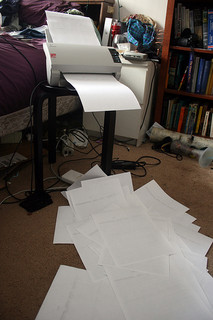
Writer’s improvement hell – repetition

Improvement

I thought I had a good post on this topic, but I’m not sure I do. There isn’t one specific improvement situation that I feel like I can speak to just now. Sure, there’s a lot of stuff I’m constantly working on, but nothing in particular is sicking out in my mind. So, instead of banging on about what I’m stuck on today, I think I’ll ramble on about a couple of things I’m constantly working on. The first is starting sentences. One of the things I try to do when I write is NOT start subsequent sentences, or even sentences in the same paragraph, with the same word. Sometimes it’s unavoidable, but most of the time it’s not. Even then, I still find myself being repetitive in this manner. Perhaps the first question one might ask is why bother? Well, it’s because it reads better that way. If I truly understood why this was, I wouldn’t be in writer’s improvement hell.

If you look at my last paragraph, you’ll notice that none of the sentences begin with the same word. The first draft had several repeats, but once it was revised to specifically eliminate these, the flow of the paragraph got better. I’m not going to try and claim it’s a golden example of how to write anything, but it does read reasonably well. Had multiple sentences started with the same word, it would feel repetitive, and that never reads well. Again, there are times when it just makes sense to repeat, so keep that in mind. An interesting side note here is when developing a presentation, I take the same approach. This tends to make the presentation seem more dynamic and less scripted. To make this work though, you need to kick in throw-away words. In the case of paragraph 1 of this blog post (for lack of a better example just now) The second sentence starts with ‘Sure’. This is absolutely unnecessary, the sentence could have just started with “there’s”. If I had done that though, it would have felt a little repetitive. Granted, not so repetitive that it would have sounded awful, but it seems better to me.

Having gone through that, there is a second writer’s improvement problem to be dealt with. That first paragraph still has a problem as far as readability is concerned. It’s the type of thing that drives my sister nuts (I’m not sure she reads these with any regularity, if so: Hello KDW and congratulations on your test!), the word ‘I’, in various incarnations, is repeated WAY too many times. This sort of repetition is probably not necessary. When writing in 3rd person, you get stuck using ‘him’, ‘his’, ‘he’, ‘her’, and ‘she’ a little more often than feels comfortable, but I couldn’t claim I’ve got an easy rule of thumb or remedy for that. There is, however, a remedy for paragraph #1. And here it is:

I sat down thinking there was a good topic for this post rolling around in my brain. Turns out, there wasn’t a specific situation I’m working through right now worth speaking to. Sure, there’s a lot of stuff I’m constantly trying to improve upon, but nothing in particular is sicking out in my mind. So, instead of banging on about today’s sticky points, I’ll ramble on about a couple of things constantly causing me heartburn. The first is starting sentences. One of the things I try to do when writing is to NOT start subsequent sentences, or even sentences in the same paragraph, with the same word. Sometimes it’s unavoidable, but most of the time it’s not. Even then, this sort of repetition creeps into my writing. Perhaps the first question one might ask is why bother? Well, it’s because it reads better that way. If the technical reason was clear to me, I wouldn’t be in writer’s improvement hell.

In the second incarnation of the first paragraph, the word ‘I’, in various incarnations, is repeated a total of six times. The first paragraph has it repeated that many times in the first two sentences. Holy crap! Is that strictly necessary? –Probably not. Now, the best part of this whole post is the fact that the issue illustrated here is something I’m constantly struggling with, and often get wrong. On the bright side, I do recognize the problem, and more than anything else, that will help me to fix it.

Fantasy book research #3 – guns and gunpowder

First question, I suppose, is what the hell are guns doing in a sword and sorcery fantasy? In short – I’m writing this story and I get to choose. When most of us think about guns and gunpowder images of white smokeless powder come into our heads. This is the stuff that you’ll find inside of modern cartridges, let’s say a .22 round, for example. My story doesn’t involve this sort of thing, otherwise it would be a lot easier. For my purposes, I’m more interested in black powder, the sort of stuff you’d find on an old wooden tall ship, or in a revolutionary war musket.

This proved to be one of the more difficult things to easily dredge up. Largely because there are thousands (millions? possibly approaching trillions?) of blogs and forums on the interwebs about guns, and you have to wade through a lot of unhelpful junk in order to find anything useful. Even then, since guns and gunpowder are so dangerous, there’s not a lot of easy to find general information out there. Most folks offering advice have an interest in making sure you don’t accidentally blow yourself up. Let’s say we ask the question: What is the volume of a pound of black powder? The answer you’re likely to find time after time is: ‘it depends’. What about: How much powder is required to fire a cannon? Again, this can be a ‘it depends’ situation. As a hapless writer who really just needs to know what is reasonable and plausible, none of this ‘it depends’ crap is helpful. In the end, I did manage to locate enough detail to sketch out an island of ‘reasonable’ for my story, here are my notes on the topic:

Black gunpowder consists of roughly seventy-five parts of saltpeter (Potassium Nitrate KNO3) to twelve and one-half parts of sulfur, and twelve and one have parts of charcoal. Once upon a time, Saltpeter was extracted mostly from animal waste through various methods OR could be mined. Either way producing it was NOT cheap (http://mysite.du.edu/~jcalvert/tech/cannon.htm)

Powder kegs are considerably smaller than kegs to transport anything else. Most traditional oak barrels run anywhere between 160-300L (about 40 to about 80 Gallons), which take up a space of something like 28” in diameter and 35” tall. One source (I’d cite it here, but I didn’t write it down. I think it was associated with the US Civil War, or possibly the British navy. In any case, I couldn’t find it when I went looking.) describes a common powder keg as containing 25lbs of powder, which translates to a container roughly 10” in diameter by 14” tall. This makes sense, because it’s a very transportable size.

The consumption of powder for a cannon can be assumed to be 1/3rd the weight of the ball (Can’t locate the source for this again), for example, a 32 pounder would consume roughly 11lbs of powder per round (http://www.cannonsuperstore.com/cannoninfo.htm). If you scale this down for a musket (and I suspect it scales reasonably well), the amount of powder consumed per shot is negligible compared to the volume of a full powder keg, something on the order of 6-8 grams (http://www.chuckhawks.com/blackpowder_volumetric.htm). You could easily get 1500-1800 rounds out of a powder keg.

And finally, (only because it’s in my notes, and was actually important for my story) rust rate of cannons:

http://www.nma.gov.au/__data/assets/pdf_file/0008/346049/NMA_metals_s2_p10_cannon.pdf

Basically, if you have a cannon sitting in open air next to the ocean for five hundred years, after a bit of cleaning, you could still probably fire it.

Anyhow, all of this looking around got me enough information to write the bits I needed to, and I think what I have seems plausible. Perhaps not perfectly accurate, but good enough.