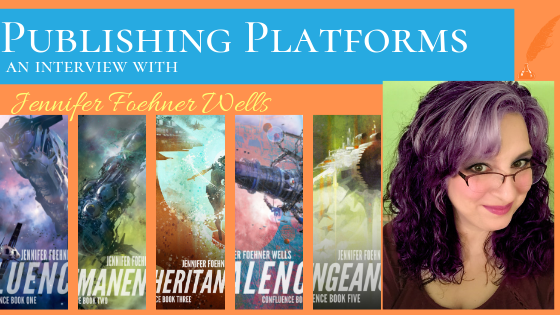
This is the second post on audiobooks with an additional perspective. As I continue to press on with self-publishing later this year I alternate between thinking ‘this is totally doable’ and ‘there is no way this is going to happen.’ For audiobooks, I’m oscillating between the two about as fast the words form in my brain. This time, I’ve been joined by Jennifer Foehner Wells!!!
D: Thank you so much for helping me out with this. Before I launch into my questions, could you tell us a little bit about yourself?
JFW: I’m a science fiction novelist that specializes in space opera. While I’d written throughout my life for fun on various topics, I first started out as a hobby writer, writing fan fiction. When my ex-husband read my magnum opus (novel-length) fan fiction he asked me, “Why aren’t you writing for profit—this is great!”
That was like a balm for my soul because I’d dreamed of being a writer since I was in elementary school. His enthusiasm gave me the confidence to do the research I needed to learn better techniques. I knew I could write scenes but the nuances of how to plot a novel had been like smoke between my fingers until then.
After an extensive learning period, I plotted and wrote my first fully original novel. At the time I was a stay-at-home mother at a crossroads. My youngest had just begun preschool. In the coming years, I knew I’d be rejoining the workforce. I expected that I’d continue hobby writing on the side as I returned to my original career in biology, but to my utter shock and surprise my first indie novel went viral in 2014 and I was launched into a full-fledged career as an author with a substantial following right off the bat. This almost never happens. I got lucky in hitting the market at the right time with [what] book readers were hungry for.
D: Before I get going, I know I pitched this as asking about audiobooks, but you’re the first person I’ve been able to talk with who started indie and is now represented by an agent, I hope you forgive me for asking a couple questions about that first. How did you go from being indie to being represented?
JFW: As I mentioned in my answer above, my first novel was a runaway freight train. I expected to write in obscurity, building my craft (which was a realistic expectation), but I ended up reaching the top 100 overall on Amazon’ s charts (not just my category) for months, selling thousands and thousands of books. A friend watching my success suggested I connect with a specific agent who was known to sometimes take on indie authors if they sold enough books. I sent him an email outlining what my numbers looked like and asking if he was interested in representing me. He was.
D: What is the biggest advantage of having an agent?
JFW: The biggest advantage for me has been having someone to handle translation negotiations overseas for me. Currently, some of my books have been translated into German, Russian, and Japanese. It’s kind of amazing to have those translations prominently displayed on a bookshelf in my home and I’m very proud of that. In addition, he handles the queries I get from movie producers and television producers. There have been quite a few of these over the years, though I haven’t yet sold an option. Still, it’s nice to have someone who knows the industry better handling those talks for me. All of my books are indie published in English, and in translation, they are traditionally published. Technically, I’m a hybrid author.
D: On twitter you said that independently producing an audiobook for an indie author with a small audience just wouldn’t be worth it. This makes a lot of sense to me. What volume of books does the production of an audio-book start making sense?
JFW: My response to this question is a bit difficult to parse. Most of my audiobooks are sold on Audible (though I’m also on iTunes and Amazon) and the Audible payment procedure is based on how a consumer purchases the book. There are two basic tiers—the bounty, when someone new to Audible selects your book as their first download, is substantial. You can earn up to $75 per bounty plus your normal take (I believe). But those would be fairly rare.
Then there is the purchase based on retail price. I believe this is the same whether the customer is an Audible subscriber or not. In my case, since I pay my narrators up-front for production, my take is 40% of the retail price for those purchases. That’s the “exclusive” contract with ACX/Audible—your audiobooks will be up on Audible, Amazon, and iTunes. You can also choose the “non-exclusive” royalty contract which also allows you to upload the files yourself to other audio sites and get a 25% royalty share with ACX. Since those other sites are still very small, I choose exclusivity for now. That’s a 7-year contract. After the 7 years are up, you can reconsider your options.
There is an additional option. Some indie authors do a royalty split with their narrators—20/20% of the profit. Instead of paying fully for production up front, the narrator is taking a gamble on the book doing well over the long term and providing income over time for them. That reduces up-front costs obviously, as well as long-term income, but will also limit the narrators willing to work with you. The most experienced and sought-after narrators do not work like this. They expect payment on completion of the work. I produced my first book this way, but the subsequent four have been produced the traditional way and I pay them $400 per finished hour (PFH), which is on the high end because I hire top-notch narrators, some of whom also work for traditional publishers. My novels are typically 9 to 12 hours long, so that’s a hefty investment.
Authors are going to have to do some math and some gambling when they decide to turn their book into an audiobook. First of all, how well is the ebook selling? Adding an audiobook that is professionally produced will lend a veneer of professionalism to that product page that (along with a visible paperback option—and most importantly, the best cover art and editing you can afford) readers definitely respond to. How long is your book? Most narrators read a book at roughly 10,000 word PFH. Sometimes, with a lot of research, you can find a narrator that hasn’t cracked through to popularity that is extremely skilled and willing to work for less as they climb the ladder. That might be the best option if you don’t have a lot of money to invest.
As you can see, there are a lot of factors involved. My recommendation is to start with ebook and print and see how that goes. If it seems promising, add an audiobook to the first book in a series. Do your research when choosing a narrator. Wait and see if readers are clamoring for book 2. I’m not even bringing advertising into this. That’s a whole ‘nother rodeo.
I’ve also been lucky enough to have my first book added to the Audible Romance Package which is a subscription service. While my book is definitely NOT a romance, it does have a romantic subplot. I consider myself lucky that they invited me to be included because it raised my book’s visibility on their site. Payment is significantly less per listen but has influenced sell-through in a positive manner. As you can see, there’s no hard and fast rule here. You’re going to have to make an educated guess and go with your gut depending on your own circumstances.
D: What does the process of hiring a narrator look like?
JFW: I’ve done this two ways. For my first book, I used the tools ACX (Audible’s funnel company) provided to listen to narrator samples and chose a narrator I thought was best for my book.
You can do this two different ways. You can post your book and wait to see who auditions within a time frame you set. Or you can sift through [the] narrator’s samples yourself at various PFH levels, looking for the right one. Neither option is easy. It’s time-consuming. And you have to be able to apply what you’ve heard to your own style and make a good match. In my case, I enlisted friends and family to listen to my options with me and help me come to a decision.
Then I made an offer using the ACX system. There may be a negotiation for PFH. Assuming they accept, you then give them deadlines based on ACX suggested timelines. They produce some sample chapters which you are allowed to critique and ask for changes on. Then they produce the full book. You are allowed a listen through and an opportunity to ask for changes. Then the narrator or the narrator’s producer uploads the files to ACX for the ACX final quality control checks before the final files go live on the site. You will be responsible for obtaining and uploading a cover image file to ACX specifications and a blurb/description of the book. That’s a pretty easy process, though I’ve had some peers have trouble with narrators flaking and bailing. That is not fun. It hasn’t happened to me, though. And to my knowledge, there’s no place to vet potential narrators to find out their reputation in the industry.
Throughout this process, you may work closely with the narrator, especially if they require pronunciation guidelines. In my books, for example, with many alien species and languages, there are plenty of nonstandard words. Up front, a good narrator will ask you questions about their delivery—tone, accents, characterization, and other aspects of narration style.
I’ve also hired a narrator directly, by approaching a narrator I enjoyed in my own audiobook listening experience. I then queried them directly and we worked together within the ACX framework to produce a book in a similar manner. In that case, I generally receive the files directly from them, pay them directly, and upload the files to ACX myself, which is a tad more difficult, but doable.
D: If you’re doing the narration yourself, are you also finding the studio, booking time, and producing it yourself?
JFW: Yes. In my case, I happened to be going to a Science Fiction convention in the same city where my narrator lives. During that trip, I booked a session with her producer to produce an audiobook of one of my lengthier short stories (technically a novelette.) So I paid for the time in her studio, which was located in the basement of her home. This is generally done in chunks of time of 2-4 hours because the human vocal instrument can’t handle much more than that.
I also paid for her to edit and produce the audio once the production was done. She sent me the final file and I uploaded it to ACX in the standard manner. I should note that this was a novelty and something I just wanted to try. I wouldn’t recommend it. Only long-form novels sell well on Audible due to their pricing structure. Unless you have a popular, lengthy short-story collection to sell, it wouldn’t be worth the investment. That said, my most enthusiastic fans have told me they’ve enjoyed hearing my voice. A more casual listener of my books wouldn’t bother with that piece in audio format since it’s free as an ebook.
D: (follow-up) Thinking about the production process in a broad sense, what does that look like?
JFW: That can vary quite a bit. Some narrators work out of a sound-proofed closet, room, or a tented area in their own home. Others go to a professional studio space that is tailor-made for this purpose. The most important part is having a soundproof studio to record in and having professional quality recording equipment. In my case, I read my manuscript from my laptop, but some narrators read from a Kindle or tablet or even from a paperback so they can make marks and notes in their own style. I had water ready to drink for breaks in narration. If I made a mistake or a noise or flubbed a word or wasn’t happy with my performance, we’d just go back a bit in the manuscript and the producer edited all of that out. She also managed the sound levels so they were consistent throughout if I got quieter or louder in my delivery. I have a background in theatre/radio/speech and it was a very tiring process. I was exhausted and parched afterward. It’s daunting even if you wrote the words and know them well.
D: You said that you went into a professional studio to record a short story yourself. While I’ve been told I’ve got a pretty good speaking voice, I’m really terrible at reading aloud, I tend to get ahead of myself and stumble. It seems like a lot of prep could help that. How did you prep for your reading?
JFW: I practiced! I also had to do quite a bit of thinking about the characters’ voices and the narration between character voices. Many narrators make marks on a physical paper copy and then have to have the page turns edited out of the final track. Keep in mind this was a fairly short story with limited characters. A good producer can make the final product completely seamless, so you don’t have to get worked up about flubs.
D: Again, thinking about reading your work yourself, what’s the ratio of studio time to produced audio time?
JFW: At minimum, the studio recording time is double the PFH. Then there’s production time on top of that, which can easily be hired out. I imagine that’s a fairly lengthy process. Most narrators I work with subcontract with a producer and pay them out of my payment to them. Keep that in mind when you’re looking for a narrator. If they’re working alone in a closet at home, you may not be getting the professional quality audio you may be waiting for your customers. That can vary and some narrators are very skilled at their own production. Just keep that in mind. Ask questions. Don’t trust blindly.
D: When reading yourself, I’d imagine you’re in a sound booth with a sound-technician in another room, is that generally accurate? What does that process look like?
JFW: In my case, the producer was in the room with me and silently following along in her own copy of the manuscript as she watched sound levels. A sound booth can look very different in different locations. In this case, it was a small room in the producer’s basement with special sound baffles on the walls to mask outside sounds, though we did have to stop briefly when the garbage trucks rumbled through that morning.
She would sometimes stop me and redirect me if I didn’t notice that I’d read a sentence incorrectly or ask me about [the] pronunciation of a word. We’d then stop recording and look up the word to see if my pronunciation was on the spectrum of correct. I have no idea if this is typical. This is just how we did it. My producer not only works on audiobooks, but also does commercial work, so I assume that’s how these things are done.
D: I see that your audiobooks are available on both Audible AND iTunes. The last author I interviewed suggested that it was difficult to work with both. Was that your experience?
JFW: Not at all. If you’re working through ACX, you just tick a box saying you want your book to be available on iTunes. It wasn’t difficult at all. But I have no experience with other audiobook uploading sites. Their rules and processes may be different. From what I’ve heard from other authors, ACX is still probably the best bet for most authors. Amazon/Audible holds the lion’s share of the marketplace. The iTunes contribution is negligible by comparison.
D: Your audiobooks are available on audible – how would you describe the process of getting listed on audible and how does the author compensation stack-up on that platform? Given the price we listeners pay for that service, I’d imagine you’d need to rely on volume there.
JFW: I won’t be deceptive—the ACX website is a bit unwieldy at times. It could use some tweaking. But it’s not terribly difficult to use. I’d just go slow and work with that system. Once the files are uploaded they handle pretty much everything. As I said above, it’s my personal opinion that ACX is still the best bet, though there are many indies shopping around and trying other options. But that may lead to difficulties like you mentioned, with getting a book up on iTunes. I don’t have any experience with that so I can only say what I’ve done and what other authors I know are telling me. Across genres, it seems as though ACX is still the best option even if other distributors give a better share of the profits. That’s going to be a marginal advantage if you don’t sell a large volume of audio books.
D: I could legitimately ask you questions all day, but to wrap it up, if there were just one thing, you’d like an author to take away from this brief set of questions on audiobooks, what would that be?
JFW: If you’re going to do an audiobook, it’s going to have to be an educated leap of faith. Like all things creative, there are no guarantees. Hope for the best, but don’t set your expectations too high. Realize that you’re serving what is now a small percentage (but growing!) of readers. Invest in audio to further your brand, show professionalism, commitment, and that you’re a serious producer, not necessarily for huge monetary gain. My audio sales (and my paperbacks) are just a small ratio of my overall sales. I’m happy to have that income, but it takes a while, even with my volume of sales, to break even. And until then ebooks are subsidizing the audio. It’s definitely a business decision. And I don’t regret it. Someone with a smaller footprint might need to hold off until their readership grows. Being analytical about, and treating it as a business decision, it is key.
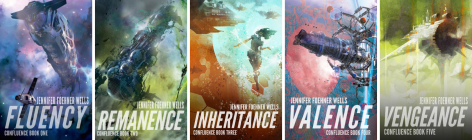
Thank you again, Jennifer Foehner Wells, for taking the time to help me out. Jennifer Foehner Wells is the author of several titles, including the Confluence Series, which you can find in ebook, paperback, and audiobook including Amazon [links], iTunes [links] – [Others? Is there another set of work you’d prefer mentioned or added to the list?] You can follow Jennifer Foehner Wells on Twitter @jenthulhu, and find her website at jenthulhu.com
 On Writing Dragons