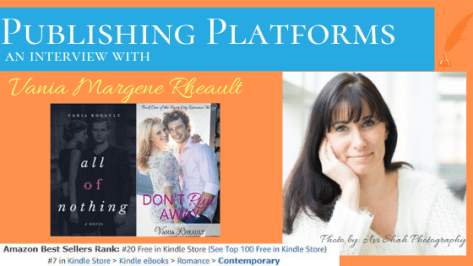
Publishing platforms interview #2, featuring Vania Margene Rheault

VMR Interview Header

For this installment of interviews on publishing, I’ve reached out to Vania Margene Rheault. I connected with Vania Margene Rheault through Twitter, originally, and find myself enjoying her Facebook meme game daily. Not only that, Vania has some really good posts on the process of publishing on her website (https://vaniamargene.com/). Here is our interview:

D: Hi Vania, thank you for taking the time to respond to my questions. Before I get going, could you say a little something about yourself and your work?

VMR: Thanks for having me, Dave! I appreciate the opportunity to chat!

I think the one thing that sticks out for me right now is how lucky I am to be in a place in my life where I can write. I see lots of people trying to write while they have little kids, or demanding jobs, or unsupportive spouses. I don’t have any of that holding me back. I found writing again when I was older, I have more time to put into it, and honestly, more wisdom and respect for the profession and the work that needs to go into it. I’m also fortunate in that I love what I write, and it’s marketable. I’ve managed to meld writing to market and loving what I write together, and I’m not kidding, it’s a daily relief.

D: You’re fairly prolific. I counted 11 romance titles on Amazon under your name. Is all of your work published by Coffee & Kisses Press?

VMR: Yes.

D: Why did you decide to create your own imprint with D.R. Willis?

VMR: Back then, because it was cool it felt to have your own imprint. David and I were talking about how difficult it was to find an imprint name that wasn’t already taken by another author or publishing house. We were lucky that Coffee & Kisses Press wasn’t taken. We share it because it was easier to come up with one rather than two. He writes mystery/suspense, so while that genre doesn’t really fit the tones of the imprint, we thought pairing up would be smart going forward.

D: What advantages do you see to having your own imprint as opposed to self-publishing without an imprint?

VMR: I used to think there were a ton of advantages. I thought no one wanted to admit they’re self-published, and having your own imprint seemed like the thing to do. Now, with so many more books in my back-list, it a small thing compared to what’s more important–writing and publishing good stories.

The biggest takeaway from having your own imprint, I would say, is buying your own ISBN numbers. There is a lot of argument about this–some authors do, some don’t, and in the USA they are very expensive–but just for my own peace of mind, I buy my own and attach one to the e-reader file and one to the paperback. Those books are mine, and I have the numbers to prove it. Listing an imprint under my ISBN numbers is just a small bonus.

D: Except for D.R. Willis, the co-owner of Coffee and Kisses Press, have you considered publishing any other authors under this imprint? Why/Why not?

VMR: I haven’t. I don’t have the time. There are certain obligations a press, even a small press, needs to fulfill for their authors. Covers, editing, formatting. Those are big things, but the biggest thing is distribution. Authors expect their presses to get them distributed worldwide, and hopefully into bookstores. Translation, audiobooks. I know absolutely nothing about any of that. I don’t know how (or can’t afford) to do it for myself, so there is no way I would say I know how, or could pay, for someone else. If I help an author with a cover or editing, or if I format for them, I do that for free, and that’s it. I don’t want to deal with royalties or advances. I know some big-time indies have gone that route, and they have the resources to do it, but it’s not for me.

D: What do you do for editing prior to publishing?

VMR: I have a very strict editing process. I like to let the manuscript sit for a little bit, a few days, maybe a week. I take a break, and blog, do my social media I ignored while writing. Then I read through it on the screen, fix obvious typos, that kind of thing. Then I print it out. I don’t write with chapters, so this is where I chunk it, create chapters. Maybe it’s the paper, but this is stage where I either take out the big sections that don’t need to be there and/or I add where I see scenes need more. I do most of my huge editing this way. After I put those edits in I have Word read it to me. This is great for finding more typos and correcting syntax (and maybe if I can ever afford audio, it’s a great way to hear how your book will sound narrated). After I’m done with that, (and if you do it right it can take a few days) I’ll pass it on to betas [beta readers] who find the rest of the typos that have slipped through. This stage is new for me because I don’t like to wait on people. When I didn’t have betas, I would proof the proof (in paperback form) and hope I would catch the rest of the typos that way. It’s amazing what pops out at you when your book looks like a book. But the last two times I’ve published I had betas help me, and for better or worse, I’ve skipped proofing the proof. It’s a lot of editing because I don’t pay out for an editor. I don’t want to wait in the queue.

D: Your covers are pretty good. I’m not much for romance as a reader, but these covers absolutely grab my attention. How do you get your covers?

VMR: I make my own covers. I buy stock images from canstockphoto.com and use canva.com (I pay for the professional upgrade) to create them. A long time ago I taught myself how to calculate the dimensions for a paperback cover, and experimenting figured out how to make a full-spread in Canva with the downloadable templates from KDP Print. Now that’s what I do in my spare time. I make fake covers so I can get better and develop my eye. There is a lot to a cover: correct DPI, bleed lines, font choice. I think with every book I get a little better, but I don’t know how to use Photoshop, and I’m very limited in GIMP, so I know my skills could be better.

D: What would you describe as your most successful marketing strategy?

VMR: I don’t have a marketing strategy. Right now I’m concentrating on building a back-list and writing more books. The indie environment is more pay to play than ever before, so when marketing you have to know how to use Amazon Advertising, Facebook ads, BookBub. Free social media doesn’t work anymore. Anyone on Twitter knows how annoying it is for authors to tweet their book links all the time, or find private DMs in their inbox with a blurb, cover, and buy link. I read somewhere that 50,000 books are published every month. That’s not even every year. Every month. It’s definitely a pay to play environment now. Pay for ads, pay for promos. And those only work if your book has a fantastic cover, a good blurb, a good first 10% [Amazon calls this the ‘look inside’]. And then after someone buys your book because all that is top-notch, then the rest of your book has to be fabulous so the reader will be blown away and leave a review. Marketing begins with a good product, and lots of indies forget that part. They worry about [their] platform, marketing, and author brand before they have written their book, never mind if it’s even a good book. You can sell a bad book, of course, you can, but you can’t build a readership on it.  

D: I feel like a lot of writers who aren’t involved in romance sort of look down their nose at romance, yet it is a tremendously popular genre. What would you say to folks who disparage this genre?

VMR: This isn’t fair, yet . . . the people who look down on romance, they almost have a point now. What was going on with #copypastecris and now the huge scandal with #ritasowhite. Publishing is a mess, but indie romance is a huge Dumpster fire. Amazon hasn’t helped, not doing anything with bookstuffers, or letting plagiarism pass through their screening system.  It takes them months, if not years, to take down accounts that do things against their terms of service. And now there’s a new thing where a group of romance writers sell[s] their book rights to each other so they can publish their books under different titles and covers –but it’s the same exact book! How can romance writers be taken seriously when all this is going on? Sure there’s money to be made –and these scammers know it.

It’s one reason I’ve taken my books wide. I don’t want to be associated with Kindle Unlimited. While taking your books off Amazon would be cutting off your nose to spite your face, I’ll still sell my books on there but distance myself. I put my books wide [wide meaning other retailers like Kobo, iBooks, Nook], just recently, and I don’t use KDP Print for expanded distribution. While dealing with IngramSpark has been a pain in the neck, I’ll use them for expanded distribution now. Maybe I’m leaving money on the table pulling my books out of KU, but going wide just seemed to be the right move for my business, and every time I hear something else going horribly wrong in the romance indie-industry that has to do with KU, I’m glad I’m out of it.

D: As an author, what do you feel is the largest challenge you face with respect to publishing?

VMR: Discoverability for sure. It’s very very difficult for readers to find your books. Especially if you go into it with the idea you can’t/won’t/don’t want to put money into your business (and don’t get me started on authors who don’t think of their books as a business). I’ve heard from authors who say they can’t spend 20 dollars on a promotion. And I’m just like, okay, but if you can’t pay, how are you going to get your books out there? I’ll let you in on a secret I’ve learned recently. Readers aren’t on social media. Not the way we are. So being involved in Writer Twitter, friending all your writer friends on Facebook, and having them all like your author page and follow you on Instagram . . .  all you’re doing is preaching to the choir. You NEED to break out of writer social media. But it’s hard for indies because you think, where do you buy books? I buy my books at Target [laughing] and my books will never be in Target. So if I want to sell my indie books to people who are willing to read indie, where do I go? What do I do? Tap into ads and target my audience, pay for promos on sites who have been at it long enough they have an enormous newsletter mailing list. If you can’t pay to put your book into the hands of readers, I don’t know what to tell you. When I did a Freebooksy ad for All of Nothing I gave away 6,000 copies (and it cost me 100 dollars to pay for that giveaway). VMR Ad.JPGThat’s 6,000 people who downloaded it and hopefully are reading it and HOPEFULLY like me enough to give it a review and buy my other books. It’s why a back-list is so important. You want a reader to like you and read through your library. But you do have to spend money, and lots of people just can’t wrap their minds around it. And that’s fine. You have to do what you can for your business. If you don’t create a quality product, if you don’t spend money on discoverability, then you can’t complain when no one is reading your book. 

D: Do you make your books available in print? What printer do you use? Why?

VMR: I do make my books available in print, though the number I’ve sold is probably less than fifty across all my books. As with going wide, offering print gives people another way to read my books. Why leave anyone out? KDP Print, with printing costs, forces you to price your books higher than some readers might like to pay, but the option is there. And right next to the ebook price, makes the ebook look like a good deal. Besides, who can resist holding their own book in their hands? Seeing it on a tablet just isn’t the same. Also, they are good for giveaways, and generally, handing out to friends. While giving an ARC away for reviews has turned into emailing someone an epub or pdf file, way back when it used to mean an actual paperback that could be turned into a keepsake. I still like to think that way.

I use KDP Print for Amazon and I’ve switched to Ingram Spark for expanded distribution. You don’t want Ingram Spark to supply your books to Amazon. You don’t want any printer to supply your books to Amazon because Amazon doesn’t play nice with anyone. I’ve heard of several instances where my friends’ books have been “out of stock” when, if they are print on demand, how can they be? I don’t have time to police my books, so I’ll play the game their way.
In the future, I plan to offer my books in Large Print as well. Joanna Penn says there is quite the market for that, that is largely untapped. But that means more formatting and different dimensions for covers, and I’ll need to fit in the time to do that . . . someday. 

D: That’s all of my questions. Do you have anything else you’d like to share or advice you’d like to give to other authors?

VMR: Just keep at it. The EL Jameses are one in a million. Writing and publishing is a long-game, and you don’t need a five-week plan or even a five-month plan. You need a five-year plan. Where do you want to be in five years? In ten? If you don’t know . . . Maybe you won’t be writing. Maybe it’s just a hobby. And that’s cool. But make sure you know what your goals are. What’s that saying? A dream without a plan is just a wish? What’s your definition of success?  Work for that.

Thanks for having me, Dave! It was fun. 🙂

I would like to thank Vania Margene Rheault again for her insight. She is the author of several titles including The Years Between Us which is on pre-order now,  and are available at these retail outlets.

The Years Between Us (on pre-order until May 1st) books2read.com/the-years-between-us
All of Nothing books2read.com/allofnothing1
Wherever He Goes books2read.com/whereverhegoes1
Don’t Run Away books2read.com/dontrunaway
Chasing You books2read.com/chasingyou1
Running Scared books2read.com/runningscared1
You can also visit her website at https://vaniamargene.com/.
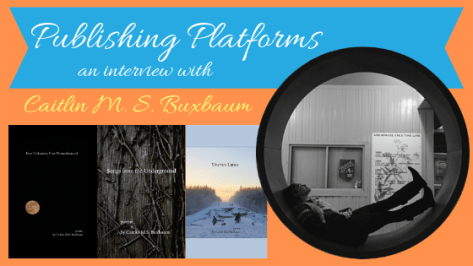
Publishing platforms interview #1, featuring Caitlin M.S. Buxbaum

CMSB Interview

This past year, I’ve made the decision to self-publish The Dark Queen of Darkness. I met with a local graphic artist/cover designer to start that process going and he offered up a tremendous amount of really good advice. This is my first time to this rodeo, so there’s a hell of a lot I don’t know, which isn’t really a surprise to me, but it leaves me with huge, icy snowdrifts of work. One of the things he pointed out was that I needed to start thinking about a publishing platform. It seems to me that everyone uses Amazon Create Space, which is what I was sort of expecting to do. However, he presented a really good argument about using a different platform so I’ve got additional avenues for advertising and marketing.

With all this in mind, I’m going to try to do a series of ‘interview-style’ blog posts asking people about their experiences with publishing. My first guest is Caitlin Buxbaum. She’s a local Alaskan author and just self-published a set of 3 books of poetry, links below. Here is what she had to say, interview style:

D: Hi Caitlin, it’s a bit funny to be asking you questions, as I remember we first connected when you interviewed me for a local newspaper when I was trying to crowd-fund for Wine Bottles and Broomsticks, which didn’t succeed.

C: Hey Dave, it is funny — I’ve actually been thinking about Wine Bottles a lot recently, but I had totally forgotten I wrote an article about it. And that that’s how we met. Whoops!

But — you totally shouldn’t give up on that book. I really liked the parts I read in terms of general storyline, and I know I laughed out loud at least once while reading it.

D: To start, could you tell me a little about what you just published?

C: Over Spring Break (which I have because I’m a teacher) I published three books of poetry: Songs from the Underground’ Ever Unknown, Ever Misunderstood; and Uneven Lanes. The first is the first compilation I made, back in 2012 as an undergrad. A lot of the poems were assignments in my poetry class at Gustavus Adolphus College with Joyce Sutphen, who was named the poet laureate of Minnesota the year before. So, I played with form and rhyme schemes a lot more — some of which I had never heard of prior to that class — and it saw a lot of peer review, some of which made it onto the back/inside pages of the book. It has some photos and paintings of mine inside as well. I’m definitely most proud of that work.

Ever Unknown came about during Camp NaNoWriMo (July) of 2013, the summer before my senior year at Gustavus. It’s a really reflective collection, with some funny family and philosophical poems in the first two sections, and some more serious pieces in the last section. It has a few photos in it, but not as many as in my first book. I think all of the poems are in free verse, except one (which, surprisingly, is probably my favorite).

Uneven Lanes is the freshest was written primarily during Camp NaNoWriMo (July) of 2017, the month I got married, so there are a lot of family-centered and, honestly, anxiety-inspired poems in that one. I was actually having a hard time coming up with a cover for quite a while, then the earthquake happened and I went out a few days later and took some pictures, and a few weeks ago realized one of them would be kind of perfect, and very Alaskan. This book is a little shorter and, dare I say, less polished than the others, but no less honest. Most of the poetry I write is pretty personal and straightforward.

I also published a book called Wabi-Sabi World: An Artist’s Search, which is a compilation of essays, photos, and haiku that I created for one of my senior thesis projects. But that’s more of an academic text I would say, which I envision being a good library resource for student research.

D: Why did you choose self-publishing for these works?

C: There are a lot of things that went into my decision to self-publish my poetry, but the two most significant, I would say, were speed and “need.” I think I spent two 10-hour days prepping and uploading my documents for publication, and they were available to buy (as eBooks) within 24 hours. That’s huge. I also thought it would be a unique way to supplement my fundraising efforts for my upcoming trip to Rwanda while gaining some measure of street cred as an author (though perhaps I was overly optimistic in that regard, haha). 

D: You chose Blurb as the publishing platform, how did you come to choose Blurb over other options?

C: So I actually published on Smashwords first, which, it’s been said, is the largest eBook distribution platform there is. I then went to Blurb to create paperback versions of my books because Smashwords doesn’t have that capability, and I already had the software downloaded on my computer (I heard about it from NaNoWriMo a while back and had played around with it). Then I did some more research and found out that most eBook authors publish on Smashwords AND Amazon, so I checked out Kindle Direct Publishing and thought ‘damn, why didn’t I do this earlier.’ 

D: Could you give me a brief description of what that process was like?

C: Oh boy. The learning curve was huge. Fortunately, I’m a quick study. So with Smashwords, I read the founder’s free eBook on how to do the thing, from start to finish. Normally I would wave my hand and say ‘Nah, I got this,’ but let me tell you — READ THE BOOK FIRST. I skimmed some parts that I later had to go back and re-read to figure out how to do things like use templates and styles instead of page breaks and individualized formatting in Microsoft Word, as well as link the table of contents to each poem. I think the whole process was definitely harder because I was working with poems, some of which use creative spacing that Word kind of gags on if you don’t set things up just right.

The way I see it, Smashwords is more for PC/analog types, whereas Blurb and Amazon/Kindle are more for Mac and iPhone users — you have less control, but in most ways, their software is more user-friendly, especially for first-timers. Kindle is a little cleaner and faster than Blurb, but at least with eBooks, it’s more limiting in terms of font styles and formatting. If you’re not using photos in your books though, I would say go with Kindle.

D: Would you use Blurb again in the future? Why or why not?

C: Now that I’ve figured out KDP, and I’m not planning on publishing any more poetry/photography combos any time soon, I’m not sure Blurb is the way to go. A lot of people do publish there but I don’t know how many actually buy books from there. Also, it’s hard to have a good profit margin because the print costs are so high; if the goal is to get strangers to actually buy your books AND make good money, you’re going to have a tough row to hoe.

With KDP, I found out after I had uploaded my manuscript that if your eBook is short enough, Amazon won’t let you charge more than $9.99, or take the 70% profit they say is an option; you’re forced to take the 35%. Same with the print versions — you can up your price, but you still get the smaller cut if your book is too short.

But if you’re only doing eBooks, Smashwords has the best profit margin, since they don’t have to print anything and you can set your price as high as you want. The problem I’m seeing now, though, is that a lot of your average readers still don’t know what Smashwords is, but as soon as you mention Amazon they sit up and take notice; they “like,” comment, share, even if they don’t buy your book.

D: Thinking about self-publishing in general, to this point, what do you feel has been the biggest challenge?

C: Marketing, marketing, marketing. My books have only been out for a couple weeks but I’m realizing very quickly that just because I have 700 Facebook friends doesn’t mean they’re all going to want to buy my books or even “like” or share a post. I’m actually kind of embarrassed by how much support I was banking on from friends and acquaintances, only to find out that some people would rather donate to a GoFundMe and get nothing in return than buy a book of poetry (and some apparently just don’t follow me or my posts at all). It’s been a very enlightening process, one which will probably go on for months. But it’s good I’m doing this now with work that I’m not as committed to as my novels before I consider self-publishing those bigger works.

D: How do you feel about the print & binding quality of your printed books?

C: I actually haven’t received any of my printed books yet, but I love the hardcover Wabi-Sabi book my dad got from Blurb, and I’ve had great experience with Photobook America (I “published” Songs and Ever Unknown for personal use some time ago) so I’m anticipating at least equal quality from Amazon, which is obviously a much more well-known company.

D: Would you self-publish again? If so, what, if anything, would you do differently?

C: I’d say it’s a solid maybe, but I think I would be more inclined to help other authors publish their stuff; like, ‘hey, you pay me to format your manuscript and remove the typos and I’ll send it back to you so you can upload it yourself.’ Because that part was a pain in the ass, but now I know how to do it, so I feel like I’ve leveled up as a writer/editor/publisher, in a way.

And next time, I would start with KDP, and maybe skip the other platforms altogether. Who knows?

I have several novels in the works, but I’m going to try querying agents for a bit longer before I think about self-publishing them.

D: Thank you for taking the time to respond to these questions.

C: No problem! Just wanted to add: I published my poetry under my full name, Caitlin M. S. Buxbaum, but I intend to publish my novels under the name Cait Buxbaum. It’s mostly a style thing, but also kind of an identity thing; I feel like a little bit of a different writer as a poet than as a novelist, and since novels are where I want to be, all my platforms emphasize that identity.

You can find Cait’s books of poetry on AmazonBlurb, and Smashwords. Learn more about Cait and her work at caitbuxbaum.com.

REALITY CHECK – Getting a one-on-one agent review

It’s no secret that writers have big egos. Even when invited to eviscerate someone’s work, I don’t want to do it because while I want to help them, I don’t want to hurt them. Usually, though, the worst ego-bruising events have to do with rejections. I mean, we all get to the point where we’ve finished something and send it off to an agent only to have a short, terse, message come back with some version of “no,” provided we get anything back at all. Normally, these things come without context or explanation. What you rarely get though, on an unsolicited query, is anything more than that. However, if you did, I promise, your ego would be harmed beyond merely ‘bruised’.

Personally, I look at a rejection and wonder, but why? What was the reason that this has been rejected? How can I improve if all I ever get is no?

This fall, I had the opportunity to get a one-on-one review of my work by a big-time New York agent with a big publishing house. To be clear, I paid for this. I thought that having this review would finally get me to the answer of “but why did you reject this?” The goal was to find a compass bearing on the improvement process. Maybe I’d even get a sense of whether or not I was writing things that could be marketable.

Spoiler alert: I didn’t come away with an improvement strategy as much as a recommendation to be a completely different writer. I also cried. And if you’re looking for a reason to ugly cry with sort of minimal collateral damage, this is a really good strategy.

The first piece we looked at was Deep Space. I read about half of the prologue in a group setting. At the time, and especially now, I regard this piece as thoroughly unfinished. Not ready for submission and not ready for beta-readers or in-depth critiques beyond perhaps that first bit. I received the very, very favorable feedback of “That’s fun, I’d read more of that” This comment was followed by some commentary on the contents and structure which I generally regard as productive, but indicates much re-writing. This was 100% in-line with expectations, except for the bit where he handed me his card and invited me to query him O_o. Best case scenario right? (well, yes, but there’s more). After having my ego so rapidly and enormously inflated, what came next was painful and, to be perfectly honest, a little bit humiliating.

The next day, at my appointed time, I went in for a one-on-one on Hexe – at the time, this one was drafted and out for early readers to come back and tell me what’s wrong. Most definitely ready for critique, in any case. I am (was) proud of this work, even after nearly trashing it this spring. It’s got some good humor, it’s got a light fun tone and the characters are memorable. So memorable that my daughter was trying to make Hexe’s castle in minecraft – high praise from her, I can tell you. So, what was my feedback do you think? I have to paraphrase this one, because we spent twenty minutes covering the same ground. “This is really, not very good. It’s solidly one-note and I couldn’t imagine reading this for… How long is it? 120K? no, cut that down to 75K, max…” and it went on. The bits of feedback can be summarized in the following bullets:

– It’s one-note

– Play it straight

– Get there faster, shorten it up

– Make the main character more likable

– and (INFURIATINGLY) The writing itself is pretty good, can’t fault that.

He then spent the last few minutes asking why the hell I hadn’t given him deep space. I told him it wasn’t ready yet, I really wanted the feedback on this one. After hearing the review of Hexe, I realized that even if I sent him Deep Space to have a look at, certainly as it was then, he was going to shake his head and say, ‘nope’. The humor and approach are really similar. I was so certain, actually, that I told him as much right there. He repeated his advice in the bullets above, and reiterated that he wanted to see more.

I feel like this is the worst spot to leave a writer. I don’t even know what to do with the comments. I mean, sure, shorten it up makes sense, but play it straight? That was a choice I made specifically to support the humor and, in fact, to give the satire a little more punch. And one-note? – I’ve been thinking about this for weeks now and still don’t know what it means or how to fix it. What’s more, I walked away with the idea that I’m not very good and that the writer’s voice I’ve finally found isn’t either. To be successful, I have to write like someone I’m not.

The same agent who’d reviewed my work pointed out that there are many millions of manuscripts written every year, and only a small percentage of those ever get to print with fewer yet making it into bookstores. Not only is this environment competitive, the odds of having a story, no matter how good, make it into print and even on to the shelf at the bookstore are a million to one against.

A rejection letter without context is a kindness. The reality is that if you knew the agent’s full reasons for not requesting more, there’s a very good chance you’d throw your laptop into the ocean and never think about writing again. So, next time you get a rejection and ask “but why?” just assume they didn’t like the concept, and keep going. If you hit the point where there is nobody else to query, maybe write something else or simply self-publish then write something else. The real, honest truth is, on average, becoming published traditionally is simply not going to happen. In a lot of ways, it’s the best and most compelling argument for self-publishing I’ve run across yet.

Anyhow, that’s what I’ve got. I’m headed back into my existential funk and clean the kitchen, which will also be critiqued and found wanting. Cheers.