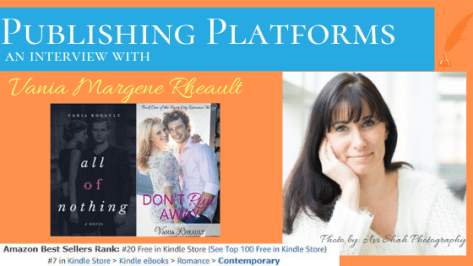
For this installment of interviews on publishing, I’ve reached out to Vania Margene Rheault. I connected with Vania Margene Rheault through Twitter, originally, and find myself enjoying her Facebook meme game daily. Not only that, Vania has some really good posts on the process of publishing on her website (https://vaniamargene.com/). Here is our interview:
D: Hi Vania, thank you for taking the time to respond to my questions. Before I get going, could you say a little something about yourself and your work?
VMR: Thanks for having me, Dave! I appreciate the opportunity to chat!
I think the one thing that sticks out for me right now is how lucky I am to be in a place in my life where I can write. I see lots of people trying to write while they have little kids, or demanding jobs, or unsupportive spouses. I don’t have any of that holding me back. I found writing again when I was older, I have more time to put into it, and honestly, more wisdom and respect for the profession and the work that needs to go into it. I’m also fortunate in that I love what I write, and it’s marketable. I’ve managed to meld writing to market and loving what I write together, and I’m not kidding, it’s a daily relief.
D: You’re fairly prolific. I counted 11 romance titles on Amazon under your name. Is all of your work published by Coffee & Kisses Press?
VMR: Yes.
D: Why did you decide to create your own imprint with D.R. Willis?
VMR: Back then, because it was cool it felt to have your own imprint. David and I were talking about how difficult it was to find an imprint name that wasn’t already taken by another author or publishing house. We were lucky that Coffee & Kisses Press wasn’t taken. We share it because it was easier to come up with one rather than two. He writes mystery/suspense, so while that genre doesn’t really fit the tones of the imprint, we thought pairing up would be smart going forward.
D: What advantages do you see to having your own imprint as opposed to self-publishing without an imprint?
VMR: I used to think there were a ton of advantages. I thought no one wanted to admit they’re self-published, and having your own imprint seemed like the thing to do. Now, with so many more books in my back-list, it a small thing compared to what’s more important–writing and publishing good stories.
The biggest takeaway from having your own imprint, I would say, is buying your own ISBN numbers. There is a lot of argument about this–some authors do, some don’t, and in the USA they are very expensive–but just for my own peace of mind, I buy my own and attach one to the e-reader file and one to the paperback. Those books are mine, and I have the numbers to prove it. Listing an imprint under my ISBN numbers is just a small bonus.
D: Except for D.R. Willis, the co-owner of Coffee and Kisses Press, have you considered publishing any other authors under this imprint? Why/Why not?
VMR: I haven’t. I don’t have the time. There are certain obligations a press, even a small press, needs to fulfill for their authors. Covers, editing, formatting. Those are big things, but the biggest thing is distribution. Authors expect their presses to get them distributed worldwide, and hopefully into bookstores. Translation, audiobooks. I know absolutely nothing about any of that. I don’t know how (or can’t afford) to do it for myself, so there is no way I would say I know how, or could pay, for someone else. If I help an author with a cover or editing, or if I format for them, I do that for free, and that’s it. I don’t want to deal with royalties or advances. I know some big-time indies have gone that route, and they have the resources to do it, but it’s not for me.
D: What do you do for editing prior to publishing?
VMR: I have a very strict editing process. I like to let the manuscript sit for a little bit, a few days, maybe a week. I take a break, and blog, do my social media I ignored while writing. Then I read through it on the screen, fix obvious typos, that kind of thing. Then I print it out. I don’t write with chapters, so this is where I chunk it, create chapters. Maybe it’s the paper, but this is stage where I either take out the big sections that don’t need to be there and/or I add where I see scenes need more. I do most of my huge editing this way. After I put those edits in I have Word read it to me. This is great for finding more typos and correcting syntax (and maybe if I can ever afford audio, it’s a great way to hear how your book will sound narrated). After I’m done with that, (and if you do it right it can take a few days) I’ll pass it on to betas [beta readers] who find the rest of the typos that have slipped through. This stage is new for me because I don’t like to wait on people. When I didn’t have betas, I would proof the proof (in paperback form) and hope I would catch the rest of the typos that way. It’s amazing what pops out at you when your book looks like a book. But the last two times I’ve published I had betas help me, and for better or worse, I’ve skipped proofing the proof. It’s a lot of editing because I don’t pay out for an editor. I don’t want to wait in the queue.
D: Your covers are pretty good. I’m not much for romance as a reader, but these covers absolutely grab my attention. How do you get your covers?
VMR: I make my own covers. I buy stock images from canstockphoto.com and use canva.com (I pay for the professional upgrade) to create them. A long time ago I taught myself how to calculate the dimensions for a paperback cover, and experimenting figured out how to make a full-spread in Canva with the downloadable templates from KDP Print. Now that’s what I do in my spare time. I make fake covers so I can get better and develop my eye. There is a lot to a cover: correct DPI, bleed lines, font choice. I think with every book I get a little better, but I don’t know how to use Photoshop, and I’m very limited in GIMP, so I know my skills could be better.
D: What would you describe as your most successful marketing strategy?
VMR: I don’t have a marketing strategy. Right now I’m concentrating on building a back-list and writing more books. The indie environment is more pay to play than ever before, so when marketing you have to know how to use Amazon Advertising, Facebook ads, BookBub. Free social media doesn’t work anymore. Anyone on Twitter knows how annoying it is for authors to tweet their book links all the time, or find private DMs in their inbox with a blurb, cover, and buy link. I read somewhere that 50,000 books are published every month. That’s not even every year. Every month. It’s definitely a pay to play environment now. Pay for ads, pay for promos. And those only work if your book has a fantastic cover, a good blurb, a good first 10% [Amazon calls this the ‘look inside’]. And then after someone buys your book because all that is top-notch, then the rest of your book has to be fabulous so the reader will be blown away and leave a review. Marketing begins with a good product, and lots of indies forget that part. They worry about [their] platform, marketing, and author brand before they have written their book, never mind if it’s even a good book. You can sell a bad book, of course, you can, but you can’t build a readership on it.
D: I feel like a lot of writers who aren’t involved in romance sort of look down their nose at romance, yet it is a tremendously popular genre. What would you say to folks who disparage this genre?
VMR: This isn’t fair, yet . . . the people who look down on romance, they almost have a point now. What was going on with #copypastecris and now the huge scandal with #ritasowhite. Publishing is a mess, but indie romance is a huge Dumpster fire. Amazon hasn’t helped, not doing anything with bookstuffers, or letting plagiarism pass through their screening system. It takes them months, if not years, to take down accounts that do things against their terms of service. And now there’s a new thing where a group of romance writers sell[s] their book rights to each other so they can publish their books under different titles and covers –but it’s the same exact book! How can romance writers be taken seriously when all this is going on? Sure there’s money to be made –and these scammers know it.
It’s one reason I’ve taken my books wide. I don’t want to be associated with Kindle Unlimited. While taking your books off Amazon would be cutting off your nose to spite your face, I’ll still sell my books on there but distance myself. I put my books wide [wide meaning other retailers like Kobo, iBooks, Nook], just recently, and I don’t use KDP Print for expanded distribution. While dealing with IngramSpark has been a pain in the neck, I’ll use them for expanded distribution now. Maybe I’m leaving money on the table pulling my books out of KU, but going wide just seemed to be the right move for my business, and every time I hear something else going horribly wrong in the romance indie-industry that has to do with KU, I’m glad I’m out of it.
D: As an author, what do you feel is the largest challenge you face with respect to publishing?
VMR: Discoverability for sure. It’s very very difficult for readers to find your books. Especially if you go into it with the idea you can’t/won’t/don’t want to put money into your business (and don’t get me started on authors who don’t think of their books as a business). I’ve heard from authors who say they can’t spend 20 dollars on a promotion. And I’m just like, okay, but if you can’t pay, how are you going to get your books out there? I’ll let you in on a secret I’ve learned recently. Readers aren’t on social media. Not the way we are. So being involved in Writer Twitter, friending all your writer friends on Facebook, and having them all like your author page and follow you on Instagram . . . all you’re doing is preaching to the choir. You NEED to break out of writer social media. But it’s hard for indies because you think, where do you buy books? I buy my books at Target [laughing] and my books will never be in Target. So if I want to sell my indie books to people who are willing to read indie, where do I go? What do I do? Tap into ads and target my audience, pay for promos on sites who have been at it long enough they have an enormous newsletter mailing list. If you can’t pay to put your book into the hands of readers, I don’t know what to tell you. When I did a Freebooksy ad for All of Nothing I gave away 6,000 copies (and it cost me 100 dollars to pay for that giveaway).  That’s 6,000 people who downloaded it and hopefully are reading it and HOPEFULLY like me enough to give it a review and buy my other books. It’s why a back-list is so important. You want a reader to like you and read through your library. But you do have to spend money, and lots of people just can’t wrap their minds around it. And that’s fine. You have to do what you can for your business. If you don’t create a quality product, if you don’t spend money on discoverability, then you can’t complain when no one is reading your book.
D: Do you make your books available in print? What printer do you use? Why?
VMR: I do make my books available in print, though the number I’ve sold is probably less than fifty across all my books. As with going wide, offering print gives people another way to read my books. Why leave anyone out? KDP Print, with printing costs, forces you to price your books higher than some readers might like to pay, but the option is there. And right next to the ebook price, makes the ebook look like a good deal. Besides, who can resist holding their own book in their hands? Seeing it on a tablet just isn’t the same. Also, they are good for giveaways, and generally, handing out to friends. While giving an ARC away for reviews has turned into emailing someone an epub or pdf file, way back when it used to mean an actual paperback that could be turned into a keepsake. I still like to think that way.
I use KDP Print for Amazon and I’ve switched to Ingram Spark for expanded distribution. You don’t want Ingram Spark to supply your books to Amazon. You don’t want any printer to supply your books to Amazon because Amazon doesn’t play nice with anyone. I’ve heard of several instances where my friends’ books have been “out of stock” when, if they are print on demand, how can they be? I don’t have time to police my books, so I’ll play the game their way.
In the future, I plan to offer my books in Large Print as well. Joanna Penn says there is quite the market for that, that is largely untapped. But that means more formatting and different dimensions for covers, and I’ll need to fit in the time to do that . . . someday.
D: That’s all of my questions. Do you have anything else you’d like to share or advice you’d like to give to other authors?
VMR: Just keep at it. The EL Jameses are one in a million. Writing and publishing is a long-game, and you don’t need a five-week plan or even a five-month plan. You need a five-year plan. Where do you want to be in five years? In ten? If you don’t know . . . Maybe you won’t be writing. Maybe it’s just a hobby. And that’s cool. But make sure you know what your goals are. What’s that saying? A dream without a plan is just a wish? What’s your definition of success? Work for that.
Thanks for having me, Dave! It was fun. 🙂
I would like to thank Vania Margene Rheault again for her insight. She is the author of several titles including The Years Between Us which is on pre-order now, and are available at these retail outlets.
The Years Between Us (on pre-order until May 1st) books2read.com/the-years-between-us
All of Nothing books2read.com/allofnothing1
Wherever He Goes books2read.com/whereverhegoes1
Don’t Run Away books2read.com/dontrunaway
Chasing You books2read.com/chasingyou1
Running Scared books2read.com/runningscared1
You can also visit her website at https://vaniamargene.com/.

 On Writing Dragons