
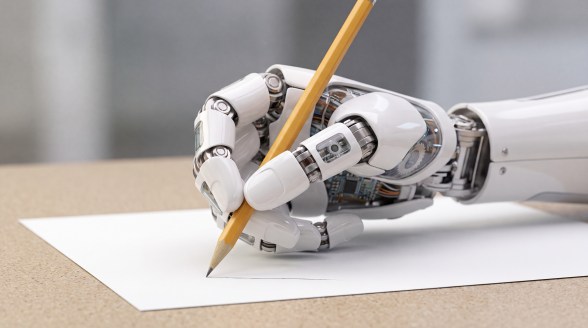
To start this series of posts, and I probably will continue to reiterate this throughout. Stories, images, code, etc… you didn’t make yourself does not belong to you. Putting your name on it, doesn’t make it your work. I am also aware of how hot of a topic this is, but it’s also a very real topic with very real implications and a lot of discussions I see are so driven by emotion that I have yet to run across a truly though-provoking exploration of the topic. So far, it’s: ‘rah-rah go AI!’ or ‘AI should never ever ever be used x1,000,000’.
From the last time I published a book until now, the writing landscape has completely changed. Among those changes is the introduction of some really impressive AI tools. One thing we as authors are having to contend with is a pile of new tools that some are using extensively and sometimes exclusively to produce content. Given the complexity and length of time it takes to write a whole novel, I can see why. I could take this time to walk out some evangelical expounding plank on either side of this discussion. But that’s not my point. My point is AI has come and it’s going to be a part of the landscape until the whole bubble bursts. Many of writers don’t have the luxury of simply ignoring it on ethical principles (even though that’s really the right thing to do). Instead, I would like to offer some perspectives on AI.
I am well aware of the problematic nature of AI:
- AI steals intellectual property to the obscene, unearned benefit of billionaries,
- it waters down of creative outputs to the point of absurdity,
- work generated by AI can’t be copyrighted (it’s not your work…), and
- AI Data-centers are destroying the health and well-being of communities across the country.
With these reasons alone, the only logical conclusion is to reject any use for any reason. At least that’s my take away, but it’s not everyone’s. To get back to the question I started with: Does AI Belong in writing? Let me start with an anecdote.
A few years ago, I attended what amounted to a sales call for the author and comedic screen writer Michael Jamin (you can look him up, he’s good and he’s legit). The presentation had been described as a one hour session teaching you about the art of comedic writing. While I naïvely thought it would in fact provide some insight on resources or something, it was more an hour-long sales pitch for a really profoundly expensive series of courses on comedic writing. He had been promoting a book at the time and I had thought perhaps it was going to be some actual insight as he pitched the book. Nope. I no longer recall much of what he talked about as it was paper thin and half-completed thoughts about good comedic writing. It was weak enough that I did NOT feel like the full course was going to be worth it. In fact, the only thing I do recall was this question about AI being asked of him. He replied without delay: “Never, there is no place for AI in writing,” then he moved on without any kind of explanation. While his response struck me as perfectly reasonable and honest, it wasn’t actually a response. At the time, ChatGPT was still in it’s early stages and I had written it off as a neat party trick and I generally agreed with that position for any kind of work. However, his answer was so terse and void of content, it made me question the position altogether. Could it really be that black and white?
In the days, weeks, and now years past that event, I still think about it and I usually ask myself – why the hell aren’t we, as authors, having conversations about this in a productive way? It seems the main focus right now (in my corner of the internet) is trying to root out authors who are using generative AI to actually produce narrative. Using AI for developing narrative is distasteful at best, but the lengths to which folks are going with it are absolutely HORRIFYING. A few weeks back, I was talking to someone about books (Dungeon Crawler Carl mostly) and it came up that she had been talking to an ‘author’ and when the person I was chatting with asked this ‘author’ about her books, the response was “‘I don’t really know what’s in them, AI wrote all of it.” she then went on to talk about how much she disliked talking to readers about the books because of this. Now, the topic had come up because I was going on about what a delight it can be to talk with readers and that had started with just how interactive Matt Dinniman is with the fandom. But this new type of ‘writer-like’ entity well, it’s the worst possible thing I could ever imagine happening to writing and authorship.
Nevertheless, even with all of the odious ethical implications AND this example of what people are doing with these tools, I actually can’t clearly and concisely just say “There is no place in writing for AI” in part because AI as a tool is a lot more than writing you book for you. In the very long-term, there may actually be a place for AI. What might be a differentiating factor in your success as an author is how to use these tools to help you as an author further your skills and more efficiently tackle some of the more time-consuming components of writing like research or narrative analysis. I don’t for a minute think these tools can really replace editors, artists, or writers, but I do think there are aspects of these tools that are undeniably useful for these folks, in spite of the ethical problems. These topics are going to be the subject of most of the rest of this series – also I haven’t written it yet 😉 so things might change just a bit.
(none of this post was generated with AI, except most probably the image, citation below)
Image by Ahmed Sadiq from Pixabay
 On Writing Dragons