This past year, I’ve made the decision to self-publish The Dark Queen of Darkness. I met with a local graphic artist/cover designer to start that process going and he offered up a tremendous amount of really good advice. This is my first time to this rodeo, so there’s a hell of a lot I don’t know, which isn’t really a surprise to me, but it leaves me with huge, icy snowdrifts of work. One of the things he pointed out was that I needed to start thinking about a publishing platform. It seems to me that everyone uses Amazon Create Space, which is what I was sort of expecting to do. However, he presented a really good argument about using a different platform so I’ve got additional avenues for advertising and marketing.
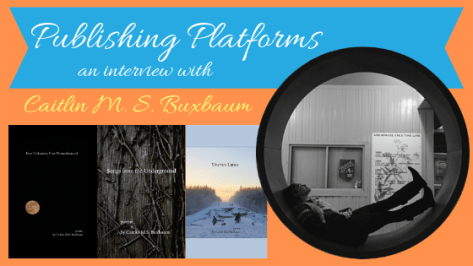
With all this in mind, I’m going to try to do a series of ‘interview-style’ blog posts asking people about their experiences with publishing. My first guest is Caitlin Buxbaum. She’s a local Alaskan author and just self-published a set of 3 books of poetry, links below. Here is what she had to say, interview style:
D: Hi Caitlin, it’s a bit funny to be asking you questions, as I remember we first connected when you interviewed me for a local newspaper when I was trying to crowd-fund for Wine Bottles and Broomsticks, which didn’t succeed.
C: Hey Dave, it is funny — I’ve actually been thinking about Wine Bottles a lot recently, but I had totally forgotten I wrote an article about it. And that that’s how we met. Whoops!
But — you totally shouldn’t give up on that book. I really liked the parts I read in terms of general storyline, and I know I laughed out loud at least once while reading it.
D: To start, could you tell me a little about what you just published?
C: Over Spring Break (which I have because I’m a teacher) I published three books of poetry: Songs from the Underground’ Ever Unknown, Ever Misunderstood; and Uneven Lanes. The first is the first compilation I made, back in 2012 as an undergrad. A lot of the poems were assignments in my poetry class at Gustavus Adolphus College with Joyce Sutphen, who was named the poet laureate of Minnesota the year before. So, I played with form and rhyme schemes a lot more — some of which I had never heard of prior to that class — and it saw a lot of peer review, some of which made it onto the back/inside pages of the book. It has some photos and paintings of mine inside as well. I’m definitely most proud of that work.
Ever Unknown came about during Camp NaNoWriMo (July) of 2013, the summer before my senior year at Gustavus. It’s a really reflective collection, with some funny family and philosophical poems in the first two sections, and some more serious pieces in the last section. It has a few photos in it, but not as many as in my first book. I think all of the poems are in free verse, except one (which, surprisingly, is probably my favorite).
Uneven Lanes is the freshest was written primarily during Camp NaNoWriMo (July) of 2017, the month I got married, so there are a lot of family-centered and, honestly, anxiety-inspired poems in that one. I was actually having a hard time coming up with a cover for quite a while, then the earthquake happened and I went out a few days later and took some pictures, and a few weeks ago realized one of them would be kind of perfect, and very Alaskan. This book is a little shorter and, dare I say, less polished than the others, but no less honest. Most of the poetry I write is pretty personal and straightforward.
I also published a book called Wabi-Sabi World: An Artist’s Search, which is a compilation of essays, photos, and haiku that I created for one of my senior thesis projects. But that’s more of an academic text I would say, which I envision being a good library resource for student research.
D: Why did you choose self-publishing for these works?
C: There are a lot of things that went into my decision to self-publish my poetry, but the two most significant, I would say, were speed and “need.” I think I spent two 10-hour days prepping and uploading my documents for publication, and they were available to buy (as eBooks) within 24 hours. That’s huge. I also thought it would be a unique way to supplement my fundraising efforts for my upcoming trip to Rwanda while gaining some measure of street cred as an author (though perhaps I was overly optimistic in that regard, haha).
D: You chose Blurb as the publishing platform, how did you come to choose Blurb over other options?
C: So I actually published on Smashwords first, which, it’s been said, is the largest eBook distribution platform there is. I then went to Blurb to create paperback versions of my books because Smashwords doesn’t have that capability, and I already had the software downloaded on my computer (I heard about it from NaNoWriMo a while back and had played around with it). Then I did some more research and found out that most eBook authors publish on Smashwords AND Amazon, so I checked out Kindle Direct Publishing and thought ‘damn, why didn’t I do this earlier.’
D: Could you give me a brief description of what that process was like?
C: Oh boy. The learning curve was huge. Fortunately, I’m a quick study. So with Smashwords, I read the founder’s free eBook on how to do the thing, from start to finish. Normally I would wave my hand and say ‘Nah, I got this,’ but let me tell you — READ THE BOOK FIRST. I skimmed some parts that I later had to go back and re-read to figure out how to do things like use templates and styles instead of page breaks and individualized formatting in Microsoft Word, as well as link the table of contents to each poem. I think the whole process was definitely harder because I was working with poems, some of which use creative spacing that Word kind of gags on if you don’t set things up just right.
The way I see it, Smashwords is more for PC/analog types, whereas Blurb and Amazon/Kindle are more for Mac and iPhone users — you have less control, but in most ways, their software is more user-friendly, especially for first-timers. Kindle is a little cleaner and faster than Blurb, but at least with eBooks, it’s more limiting in terms of font styles and formatting. If you’re not using photos in your books though, I would say go with Kindle.
D: Would you use Blurb again in the future? Why or why not?
C: Now that I’ve figured out KDP, and I’m not planning on publishing any more poetry/photography combos any time soon, I’m not sure Blurb is the way to go. A lot of people do publish there but I don’t know how many actually buy books from there. Also, it’s hard to have a good profit margin because the print costs are so high; if the goal is to get strangers to actually buy your books AND make good money, you’re going to have a tough row to hoe.
With KDP, I found out after I had uploaded my manuscript that if your eBook is short enough, Amazon won’t let you charge more than $9.99, or take the 70% profit they say is an option; you’re forced to take the 35%. Same with the print versions — you can up your price, but you still get the smaller cut if your book is too short.
But if you’re only doing eBooks, Smashwords has the best profit margin, since they don’t have to print anything and you can set your price as high as you want. The problem I’m seeing now, though, is that a lot of your average readers still don’t know what Smashwords is, but as soon as you mention Amazon they sit up and take notice; they “like,” comment, share, even if they don’t buy your book.
D: Thinking about self-publishing in general, to this point, what do you feel has been the biggest challenge?
C: Marketing, marketing, marketing. My books have only been out for a couple weeks but I’m realizing very quickly that just because I have 700 Facebook friends doesn’t mean they’re all going to want to buy my books or even “like” or share a post. I’m actually kind of embarrassed by how much support I was banking on from friends and acquaintances, only to find out that some people would rather donate to a GoFundMe and get nothing in return than buy a book of poetry (and some apparently just don’t follow me or my posts at all). It’s been a very enlightening process, one which will probably go on for months. But it’s good I’m doing this now with work that I’m not as committed to as my novels before I consider self-publishing those bigger works.
D: How do you feel about the print & binding quality of your printed books?
C: I actually haven’t received any of my printed books yet, but I love the hardcover Wabi-Sabi book my dad got from Blurb, and I’ve had great experience with Photobook America (I “published” Songs and Ever Unknown for personal use some time ago) so I’m anticipating at least equal quality from Amazon, which is obviously a much more well-known company.
D: Would you self-publish again? If so, what, if anything, would you do differently?
C: I’d say it’s a solid maybe, but I think I would be more inclined to help other authors publish their stuff; like, ‘hey, you pay me to format your manuscript and remove the typos and I’ll send it back to you so you can upload it yourself.’ Because that part was a pain in the ass, but now I know how to do it, so I feel like I’ve leveled up as a writer/editor/publisher, in a way.
And next time, I would start with KDP, and maybe skip the other platforms altogether. Who knows?
I have several novels in the works, but I’m going to try querying agents for a bit longer before I think about self-publishing them.
D: Thank you for taking the time to respond to these questions.
C: No problem! Just wanted to add: I published my poetry under my full name, Caitlin M. S. Buxbaum, but I intend to publish my novels under the name Cait Buxbaum. It’s mostly a style thing, but also kind of an identity thing; I feel like a little bit of a different writer as a poet than as a novelist, and since novels are where I want to be, all my platforms emphasize that identity.
You can find Cait’s books of poetry on Amazon, Blurb, and Smashwords. Learn more about Cait and her work at caitbuxbaum.com.

 On Writing Dragons