
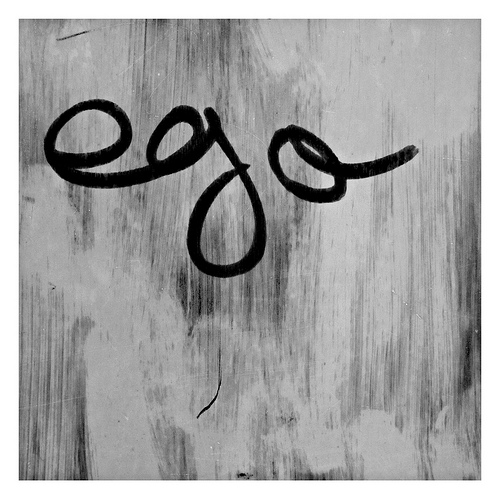
Writer’s ego and perfectionism

ego

“You’re a writer, surely you can find a better adjective.”

That came from my wife last week. I probably could have come up with a better adjective. What I couldn’t do though, and this still bothers me for some reason, was identify with that label.

Writer.

To me, writer, implies a level of professionalism and accomplishment, at least as far my own work is concerned. It’s not that I object to anyone who can identify themselves with that label. In fact, I wish I could bring myself to say: Hello, I’m a writer. I’m just not there yet. I don’t have anything in a state where I could justify it.

I feel like this is a symptom of “writer’s ego.” (No, I can’t call myself a writer, but I totally have one of these.) It’s the same thing that makes me kick and scream like a spoiled child when I get feedback explaining that something isn’t working. It’s also the same thing driving me on -that little voice saying “this project is a serious, professional piece of work, and it will launch my professional writing career.”

Normally, the screaming child part of me eventually shuts up so that I can fix what’s wrong, and the part of me fantasizing about being a professional writer becomes humble so I can focus on improvement. However, this identification thing is causing a problem. On one hand, who cares about being labeled a writer, if you enjoy doing it, then it doesn’t matter what you’re called. Well, I suppose I do care, and I care because a failure to associate with the label is a symptom of not taking myself seriously.

I may be a bit of a slob, but when it comes to crafting, I’m a perfectionist. When I set out to do something, it is NOT half-assed. My wife will attest to this character flaw. Case in point:

Electric bass

Homemade electric bass

Except for the neck, and electronics, I designed and made this. It is my second attempt at making a musical instrument, the first was from a kit. I am not a luthier, nor am I a particularly fine woodworker, but this thing sounds pimp, and I am still completely unsatisfied with it. That said, I’m not going to go into the odd details I hate that no one will ever notice.

I spend at least an hour a night writing, and many more hours discussing plot, characters, setting, and so on with my wife and anyone else who’s foolish enough to listen. On those days I commute to work, much of that drive is spent thinking about my story. Not only that, when I get to a bit of story containing details I’m unfamiliar with, I start researching. On one occasion, I was at the table with a bit of string and my map. “What the hell are you doing there?” My wife asked. It was pretty obvious to me. I was doing a rough measurement of a road to make sure the the distances and travel times I had were plausible.

So, with all of that effort, shouldn’t I be taking myself seriously? After all, I want others to. If I write my book and publish it, it’ll be hard to convince folks it’s a good read, if I haven’t even convinced myself. Just one more thing to work on I suppose.


photo credit for header photo: ego via photopin (license)

So, what’s next? – a progress report

desk

My sun-room window overlooks a swamp, which is currently full of leafless trees. They’re dripping with fresh rain that should have come down in the form of three or four inches of fluffy snow. Our little flock of ducks are happily waddling about the yard grubbing, for who knows what, in the muddy ground. I, however, am sitting here, thinking about writing and not actually doing it.

Right now, my current project has progressed to being about 1/2 to 3/4s done with chapter 16 (for context, this is about 72,000 words through the book). The next few chapters charge into territory I haven’t yet covered in any draft. This is partly because the original ‘next chapter’ has been moved off to chapter one of the subsequent book. However, that’s not the main reason it’s uncharted for me. While it’s true I’ve spent countless hours on nit-picky details, various bits of polishing, and improvement in content and craft, I’ve never been this close to the end of a book.

Instead of all of the motivation and excitement I should be feeling, I’m dreading what’s coming next. Shouldn’t I be pleased with my progress? After all, I’ve nearly passed an important milestone in my writing career. For whatever reason, I just can’t mentally bring myself to that place. It’s not that I’m totally lost on what to do next. In fact, what needs to happen is pretty clear, but it’s going to be difficult, and like anything that seems hard, it’s causing me a major procrastination jag.

The ending has to be tidy, exciting, and fill in some open questions, while at the same time building up to the next book. Most importantly, everything needs to come to the inevitable ending that’s not so predictable the reader knew how it was going to end by somewhere in the 4th chapter. I seriously doubt I’m going to have that problem. What I may have trouble with though is making that riveting and inevitable ending plausible.

I suppose the only course of action here is to just get the lead out. Once I get started, the last few chapters shouldn’t really take more than a few weeks to draft up. As always, there’s revision and polishing to clean up any messes, and feedback from those helpful test-readers who have already given me a tremendous amount of help.

Thinking about the information dump #4

thinking

This post was actually a comment on a different thinking about the information dump, but I like it and it deserves it’s own post. So, to give proper credit, this post comes from Pontius Cominius. Visit Pontius’ site (if you don’t, I’ll know!):

https://pontiuscominius.wordpress.com/

This is an angle I hadn’t considered, but should have. It is an elementary kind of problem that gets at the root of other problems. This comment is also one of the reasons I blog on writing. Thank you, Pontius’, for sharing this thought.


Lemme throw in the fourth alternative. It’s sort of like Fog of War, which isn’t just a setting on many different war games that allows you to look at the enemy troop dispositions. Fog of War, or rather, Fog of Life, is that there are no pat explanations for most things that happen to you. If I’m driving on a freeway and then there’s a traffic jam, and I finally get to the end of the jam and there’s NOTHING THERE, it annoys me greatly. I want to know why we were slowing when there’s no apparent reason. It could be that there was a phantom accident there from 2 hours ago, and the traffic is still clearing, or a dog ran across the freeway 3 minutes ago and now is gone or squished, but regardless, as a normal enough human my curiosity has not been sated.

In the infodump world, I’d turn on the radio and they’d announce there had been an accident there and there was still slowing even though the accident cleared, or the know-it-all character in the passenger seat would announce, “I saw that accident there two hours ago, I should have warned you.” In real life, that very rarely happens. I go on with driving to my destination and I don’t know why I was in that traffic, but I can guess.

Likewise, in your fantasy story, to drive your narrative on, skip the infodumps and the know-it-all character. The KIAC is a pain in the keester, because the reader will say, “if KIAC knows it all, why doesn’t HE do the quest?” And the author mumbles something about KIAC not being suitable, not wanting to take it on, and so on.

Further, human nature leads most of us to avoid embarrassment by asking obvious questions. If I hear a conversation where some writers are talking about Kee-ack, if I have no skin in the game I may ask “what’s a Kee-ack?” And they’d say “Know-it-all character.” If I was worried about losing face or respect, I’d keep my mouth shut because I’m afraid the authors will mock me later or even right now for not knowing.

My seven year old frequently doesn’t know words I use. I have to prompt him to find out – “do you know what _________ means?” “No.” Explanation then follows. I know that his level of understanding isn’t high, he’s seven. Your character who is thrust into this old war with rules he does not understand is going to either have to be an extraordinary person who will ask the questions, or he will go through being ignorant and suffering for it. Which kind of character is he? People don’t usually volunteer helpful information to new people. You gotta be proactive.

There’s more conflict in the ignorance, if you think about it. Your characters only know what they each know, and it’s compartmentalized, and they don’t share important information with each other, they don’t always realize that something important is important, and you end up with confusion and ignorance and conflict.

An example is Pearl Harbor. There was a radar station set up on Oahu and it was manned when the Japanese air attack first came in. We know that it was a massive air attack. The radar operators thought it was a glitch of the new machinery. The higher ups either disregarded it or didn’t get the message. What if they’d scrambled the air assets to get armed and up in the air, and gotten the ships ready with ammo and men to man the AA guns and fought? Was there even time enough for that? It’s the hindsight we have to see the clumsy ignorance of people having pieces of the puzzle but not knowing there was a puzzle or that their piece was key.

Finally, your KIAC is flesh and blood and has opinions and thoughts and fuzzy, incomplete or just wrong information. He’s biased. And that bias is going to come out in the information he gives your protagonist. He may be well-meaning, or he may be envious of your protagonist and set him up with dangerous or bad information. That gives you more conflict and if you can’t trust the KIAC, it introduces a level of paranoia to things. Nothing is black or white.